
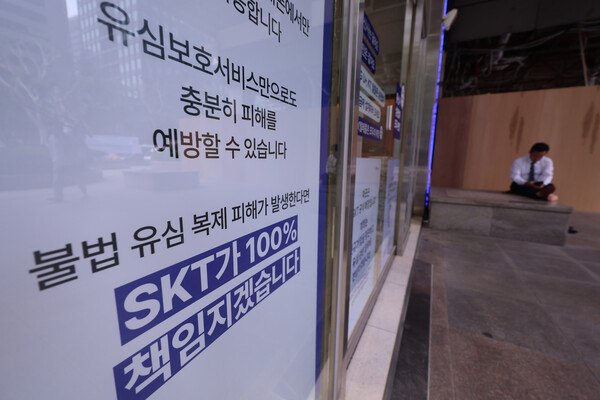
SK Telecom, which suffered a hacking incident last year, has regained a significant portion of trust through large-scale security investment and customer-protection measures, an assessment has found.
At a discussion forum on "corporate management crises and response principles" hosted by the Korea Media Management Association on Oct. 28, Shin Min-soo (신민수), a professor at Hanyang University, analysed SKT’s response after the SIM hacking incident under the theme of "how to restore corporate trust."
◆"Suspension of new sign-ups and penalty waivers strengthened corporate accountability"
Last year, 25 types of SIM information, including phone numbers and International Mobile Subscriber Identity (IMSI) numbers, totalling 9.82 gigabytes, were leaked to the outside due to a SIM hacking incident at SKT. The scale of damage reached about 26.96 million cases based on IMSI. As customer-protection measures, SKT implemented free SIM replacements, expanded its SIM protection service and suspended new sign-ups. It also carried out cash-equivalent support measures in parallel, including waivers of cancellation penalties and customer compensation programmes.
Shin gave particularly high marks to the suspension of new sign-ups and the waiver of cancellation penalties among the customer-protection measures SKT implemented after the incident. He said the company prioritised protecting existing customers while accepting revenue losses. "In particular, shifting the cost burden to the company through the suspension of new sign-ups and waiving cancellation penalties was something SKT did well," he said. "It is an example in which the value of putting customers first did not remain an advertising slogan but led to a choice reflected in the company’s profit and loss," he added.
He said the "visiting SIM replacement service" for digitally vulnerable groups was a customer trust-recovery measure that is rare even overseas. He described it as a step that reduced blind spots in customer protection by visiting customers who had difficulty going to stores. "Trust is assessed not by the average customer but by whether the most vulnerable customers are actually protected," Shin said.
Still, he pointed to limits in that the free SIM replacement implemented to protect customers instead amplified complaints. In the early stages of SIM replacement, long waiting lines formed in front of SKT stores due to a shortage of supplies. Shin recalled it as "a situation in which both the company and consumers felt wronged." He said consumer inconvenience and the burden on front-line staff increased because the company did not sufficiently check inventory, reservations and in-store processing capacity in advance.
◆Security investment and customer-protection results... cancellation rate returns to pre-hacking levels Shin also attached significance to SKT announcing 700 billion won worth of information security investment over 5 years and a 500 billion won customer compensation programme, and pushing for a security system overhaul and external verification. He analysed the publication of an information security white paper and the operation of a customer trust committee and a customer advisory group as measures that turned incident response into long-term steps to improve the customer experience.
He said security failures amid long-term hacking attempts, insufficient initial explanations and confusion during the SIM replacement process still remain tasks to be resolved. Disputes over legal responsibility also remain. SKT has filed a lawsuit seeking to cancel a 134.8 billion won penalty imposed by the Personal Information Protection Commission. Shin said that considering factors such as voluntarily implementing protective measures, the lack of actual damage to customers and fairness in calculating the penalty, the company also has grounds to contest the legal judgement.
Ahn Jung-min (안정민), a professor at Hallym University who presented alongside him, emphasised that technical recovery from failures should be separated from restoring customer trust. "Even if the technical cause is resolved, customer damage and distrust may remain," he said. He suggested distinguishing between the cause of the incident and the routes through which damage expanded, and including in crisis management the impact on customers and partner companies.
Meanwhile, Shin said SKT’s average monthly cancellation rate rose to 1.6 percent in the second quarter of last year immediately after the incident, then fell to 0.8 percent in the second quarter of this year, a level similar to 0.7 percent in the first quarter of last year before the incident. "I think the measures SKT took were effective in restoring consumers’ trust," Shin said. He added that SKT ranked first this year in major customer satisfaction surveys including the National Customer Satisfaction Index (NCSI), the Korea Service Quality Index (KS-SQI) and the Korea Customer Satisfaction Index (KCSI).
Lee Hye-yeon (이혜연), head of SKT’s Customer Value Innovation Office, said, "We can build trust only by moving customers’ hearts through continuous efforts." "We will pay even closer attention to customers’ voices and connect that to improving the customer experience," she said.
 Jin-ho Lee
jhlee26@d-today.co.kr