
Samsung Electro-Mechanics said on Oct. 28 it posted third-quarter consolidated revenue of 3.76 trillion won and operating profit of 691.0 billion won. Revenue rose 30.3 percent from a year earlier and operating profit increased 165.5 percent. Its operating margin came to 18.4 percent.
Both revenue and operating profit were record highs for a quarter. From the previous quarter, revenue rose 8.9 percent and operating profit climbed 56.9 percent, extending the uptrend. Profitability indicators also improved. Net profit for the third quarter was 485.0 billion won, up 115.7 percent from a year earlier, and profit before income tax was 609.7 billion won, up 116.4 percent.
Cumulative revenue for the first three quarters was 10.43 trillion won and cumulative operating profit was 1.41 trillion won. From a year earlier, cumulative revenue rose 24.0 percent and cumulative operating profit increased 109.5 percent.
AI products drove the results. The company explained that broader sales across component applications, growth in data centre and automotive FCBGA, and expanded supply of camera modules for next-generation platforms at global EV makers led to the increase.
By division, component revenue was the largest at 1.88 trillion won. It rose 36 percent from a year earlier and 14 percent from the previous quarter. Sales increased across applications, centred on AI data centres such as servers, networks and power.
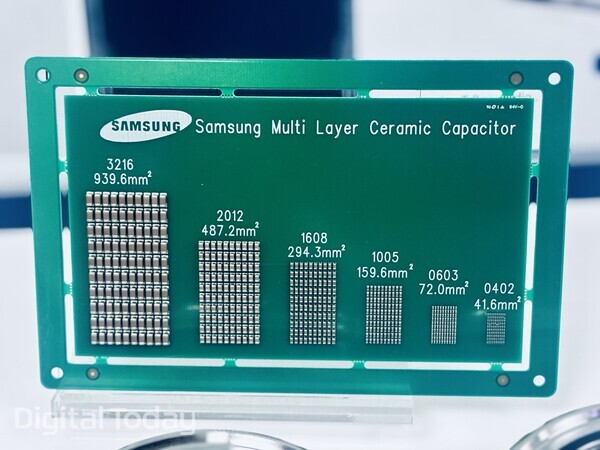
As AI server GPUs become higher performance, demand has risen for higher-capacity and ultra-miniaturised MLCCs as GPU performance increases, sharply lifting demand for Samsung Electro-Mechanics products. The industry calls the phenomenon in which MLCC capacitance required per GPU and ASIC doubles every year the "AI MLCC law". Higher AI semiconductor performance links directly to rising MLCC demand.
Revenue at the Package Solutions division was 939.0 billion won, up 58 percent from a year earlier and 22 percent from the previous quarter. The rise came as supply increased for high value-added products for server CPUs, AI accelerators and networks, as well as for high-performance substrates for ADAS and autonomous driving.
Revenue at the Optical Solutions division was 941.3 billion won, down 9 percent from the previous quarter. It was the only one of the three divisions to fall from the previous quarter. From a year earlier, it rose 3 percent. New mass production of 200-megapixel folded-zoom products, expanded supply for foldable phones, and expanded supply for next-generation platforms for global EVs helped improve results.
The company said it expects strong demand for high-spec products for AI data centres to continue in the fourth quarter. It also forecast steady demand for automotive components as autonomous driving technology advances.
The Components division plans to increase supply of small, ultra-high-capacity AI products and to move up development of cutting-edge products to pre-empt the market. The company said it is also continuing to respond to long-term supply contracts with major big tech customers.
The Package Solutions division will respond to data centre customers' requests to expand supply. It plans to supply new high value-added FCBGA products on schedule and to expand production capacity by location.
The Optical Solutions division will mass-produce high-definition, slim cameras for next flagship models for strategic customers. It also plans to expand supply of automotive products as demand grows with advances in autonomous driving and the commercialisation of humanoids.
A Samsung Electro-Mechanics official said the company is continuing to respond to long-term MLCC supply contracts centred on major big tech customers and plans to pre-empt the market through early development of cutting-edge products. The official said it will respond in a timely manner to customer requests to expand supply of package substrates related to AI data centres, and will supply camera modules for next-generation platforms to global EV customers to expand revenue.
 Suk Dae-geon
d2dg@d-today.co.kr