
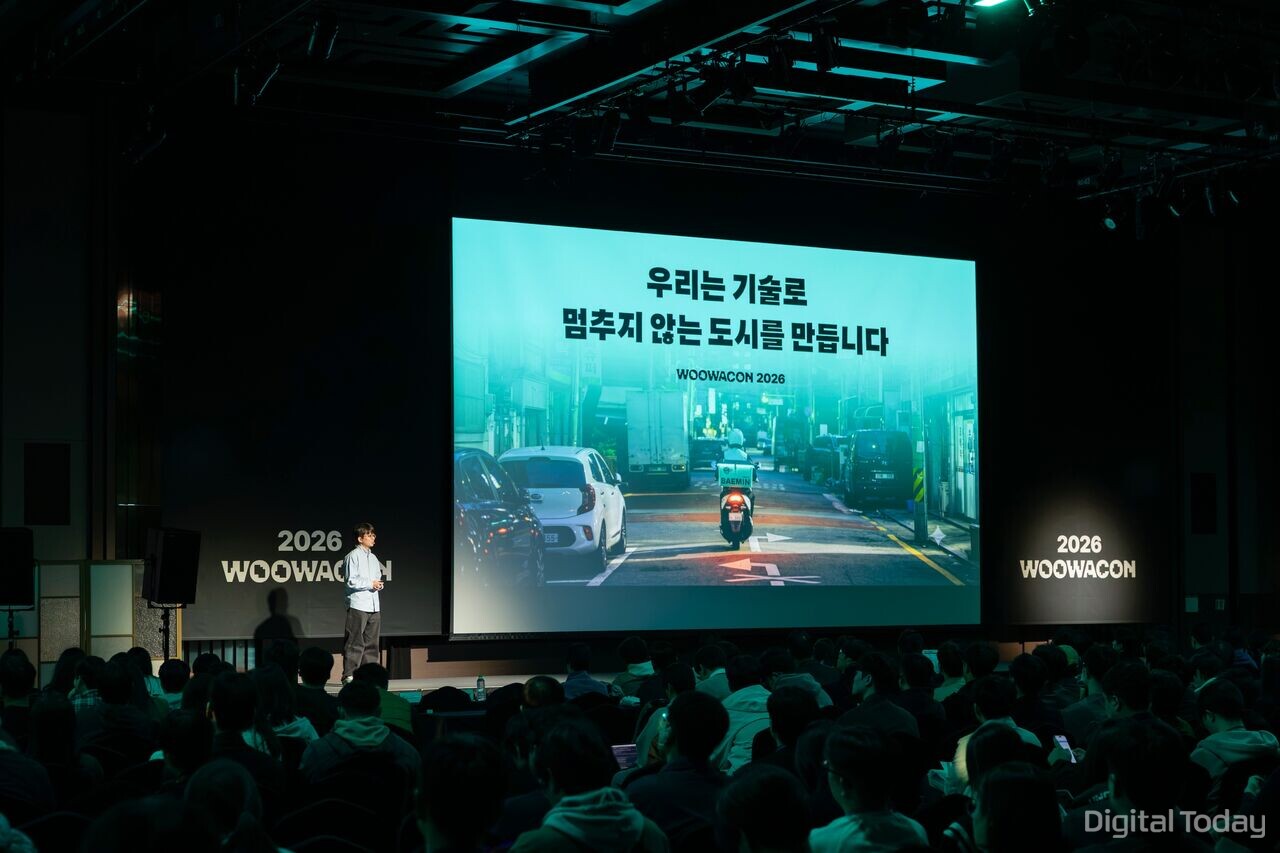
Woowa Brothers unveiled a plan to build a customer-focused city it calls “Seamless City.” Woowa Brothers, the operator of food delivery app Baedal Minjok, said it held “Woowa Tech Conference 2026” (Woowacon) on Oct. 28 at the Grand InterContinental Seoul Parnas in Seoul’s Gangnam district.
The theme of this year’s event is “technology that builds a city that does not stop.” Launched in 2020, Woowacon is a forum for sharing Baemin’s technical achievements, insights and future vision. This year’s conference hosted more than 40 sessions on AI and machine learning, backend and frontend, mobile apps, data, organizational culture and robots. The opening keynote featured Chief Executive Kim Beom-seok (김범석), Chief Technology Officer Ko Myeong-seok (고명석) and Daniel Han (한다니엘), head of delivery, in that order.
Ko first introduced the company’s AI results. Cooking times entered by store owners previously differed from actual times by about 8 minutes. After introducing a prediction model that reflects order volumes and processing speed by menu item, the company said the average error fell by 50 percent.
The company also changed its delivery-time prediction method to use 58 data points, including delivery conditions by store and local congestion, lifting accuracy by more than twofold. It said AI agents that make decisions and execute tasks on their own are also used in a hyper-personalization engine that determines benefits and recommendations based on about 3,000 customer variables.
Han explained on-the-ground applications by tracing a single order on a rainy evening. Baemin forecasts rider demand by region during peak hours before rain and secures the needed workforce in advance. The company said response time in rainy weather is shortened by about 80 percent. When delivery-time guidance relied on information entered by store owners, it matched reality in about 3 out of 10 cases. Now it makes predictions based on what actually happened by store, area and time of day.
Robots have also been deployed in deliveries. In some areas, robots carry “B마트” orders to customers’ doors, drive autonomously for more than 99 percent of the total distance and travel about 5,000 km each month. In route experiments, riders did not often choose straight-line routes on maps, and even when they did, it was not always faster. Han said rider demand, estimated arrival times and travel routes are set through experiments and data, not intuition. The company also designed its system so that if a service error occurs while processing an order, it can resume from the step where it stopped.
Kim said the city Baemin wants to create is a “Seamless City,” where what customers want reaches them at the moment they need it. He said South Korea’s population is 7 times smaller than the United States, but the number of restaurants is far higher in South Korea. He added that the company is solving problems in a dense, complex market by predicting orders that have not occurred and linking customers, stores, riders and robots, then optimizing to make many decisions in real time in a variable-heavy reality.
 Dae-geon Seok
d2dg@d-today.co.kr