
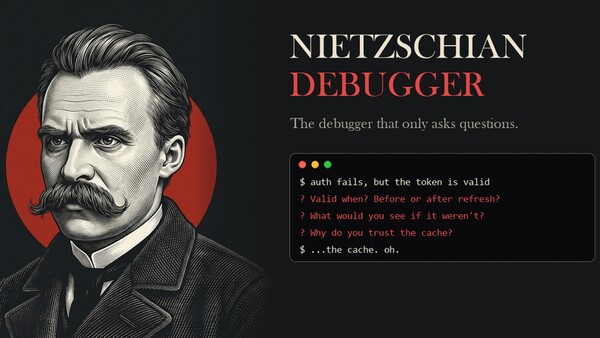
A distinctive AI debugging tool has emerged that keeps asking developers questions instead of telling them how to fix program errors. Its feature is to steer developers away from relying on AI to patch code and prompt them to identify the cause of a problem on their own.
On Oct. 27 (local time), Japanese media outlet GIGAZINE reported that an open-source tool, the Nietzschian Debugger, designed to help developers build their own error-fixing skills, was released on GitHub.
The tool began from concern that developers’ problem-solving ability could weaken when they use AI-provided code as is. It is named after German philosopher Friedrich Nietzsche and reflects a philosophy that overcoming hardship helps people grow.
In a study Anthropic 발표ed in January, developers who received AI coding support scored lower in comprehension assessments than a group that wrote code on its own. The AI-using group averaged 50 percent, while the non-using group scored 67 percent. It was a short-term experiment with 52 participants, so it cannot definitively conclude that AI reduces long-term development ability.
Using the Nietzschian Debugger is simple. When a developer enters an error, the AI asks questions to track down the cause instead of presenting a corrected version of the code.
For example, if a user enters that some users are seeing a login error, it asks what differences exist between normal users and those encountering the error. If the developer answers that it is a random error, it guides them to check server logs and authentication information. It then continues with additional questions based on the developer’s answers to help them find the cause themselves.
Its questioning styles are divided into three: Socrates (Socrates), Nietzsche (Nietzsche) and Zarathustra (Zarathustra). Each serves to make vague explanations more specific, verify the developer’s incorrect assumptions, and encourage them not to give up on solving the problem.
It also supports features such as reading actual source code and asking questions, or assessing a developer’s ability to validate assumptions and gather evidence. Conversation records are saved locally.
The tool does not exclude AI. It uses Anthropic’s Claude by default, and the latest version also supports other AI models and local models.
The developer explained, "The goal is not for AI to find the correct answer on a developer’s behalf, but to make the developer think for themselves."
 Choi Jae-won
ittt_0801@d-today.co.kr