
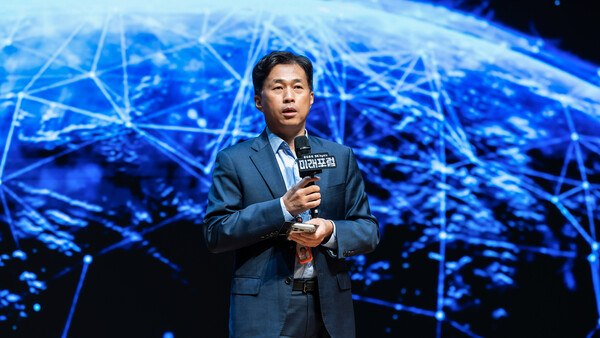
SK hynix Chief Executive Officer Kwak Ro-jeong (곽노정) said he has halted a review of an initial public offering for Solidigm. He said volatility in financial markets and a correction in semiconductor stocks make it difficult to secure the benefits initially expected.
Kwak appeared in person on Oct. 28 for SK hynix's third-quarter earnings announcement. It is unusual for the CEO to attend an earnings briefing.
Kwak said, "After comprehensively considering recent volatility in financial markets and the stock price correction in the semiconductor industry, we judged that, at this point, it would be difficult to sufficiently achieve the effects we initially expected through an IPO." He added, "Accordingly, Solidigm decided to stop reviewing a pre-IPO and an IPO."
SK hynix has been reviewing ways to secure funding needed for growth investment, such as expanding new production facilities, to respond to rising memory demand. There had also been expectations that using external capital through an IPO could ease SK hynix's investment burden and widen room for shareholder returns.
He said, "Solidigm will continue to strengthen its competitiveness in the AI data centre storage market and secure growth opportunities." He added, "Investment for this and funding plans will be pursued in a direction consistent with enhancing Solidigm's and our corporate value and shareholder value."
He also explained the rationale for returning investment gains from Kioxia through a special dividend. He said the move reflects a principle of sharing most of the results with shareholders when strategic investments bear fruit.
Kwak said, "In the process of preparing for the future, we will fill, with those results, shareholder return capacity that may temporarily decline, while continuing more bold investments for sustainable growth and protecting the interests of shareholders." As a result, of the 20,000 won dividend per share for the third quarter, 10,000 won consists of a special dividend sharing the results of the Kioxia investment.
SK hynix said it posted third-quarter revenue of 104.62 trillion won and operating profit of 83.33 trillion won. Revenue rose 327.9 percent year on year and operating profit increased 632.1 percent. The operating margin was 80 percent. Quarterly revenue topped 100 trillion won for the first time. It said the results reflected higher prices for key products amid expanding AI memory demand, along with increased shipments of HBM4 and higher sales of DDR5 for servers.
 Seok Dae-geon
d2dg@d-today.co.kr