
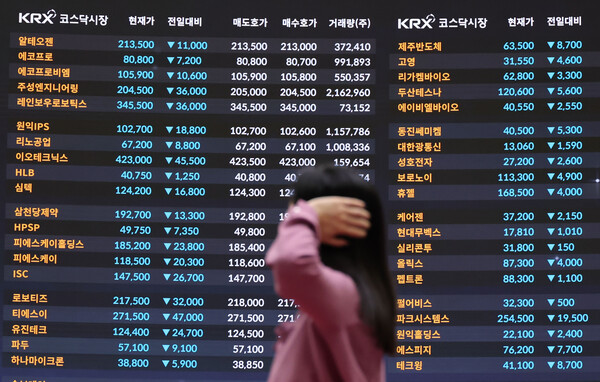
[DigitalToday reporter Oh Sang-yup] The government is trying to improve the Kosdaq market on multiple fronts, but progress is proving difficult. After moves to delist firms that fall short of market capitalisation thresholds, efforts to delist so-called "penny stocks" with share prices below 1,000 won have also become entangled in legal disputes, slowing the removal of weak companies.
According to the Korea Exchange on Oct. 27, the Kosdaq ended at 743.83, up 16.62 points, or 2.29%, from the previous session. Despite the rebound, the index is down 12.98% so far in October.
Kosdaq previously rebounded in August, rising 15.91%, and extended gains in September with a 2.59% increase. But in October it has given back most of those gains as volatility widened in domestic and global stock markets.
In particular, on Oct. 15 the Kosdaq fell 7.65% in a single day, triggering a sell-sidecar and circuit breaker in succession during the session. It rebounded 4.46% the next day, but an unstable trend has persisted and investor sentiment has struggled to recover.
As volatility rises in the Kosdaq market, efforts to restructure the market - centred on removing weak firms and fostering strong ones - are also failing to pick up speed.
The exchange recently decided to delist five Kosdaq-listed companies - TKG Aekang, Newintech, Hyungji Global, Barunson E&A and Ice Cream Edu - citing failure to meet share price requirements. It was the first case of delisting decisions made under the penny-stock criteria since delisting requirements were tightened in July.
However, procedures were halted after three companies - Newintech, Hyungji Global and Barunson E&A - filed for an injunction at the Seoul Southern District Court to suspend the effect of the delisting decision. The exchange decided to withhold the firms' liquidation trading until circumstances change, including the court's ruling.
Delistings due to failing to meet market capitalisation thresholds were also previously halted by a court decision. The Seoul Southern District Court on Oct. 2 granted injunction requests filed by Juyontech and KM Pharmaceutical against the exchange to suspend the effect of delisting decisions.
As a result, the exchange decided to maintain the designation of issues under administrative supervision based on insufficient market capitalisation, but not to proceed with subsequent delisting procedures for the time being.
The court was reported to have taken issue not with the market capitalisation criterion itself but with ensuring procedural participation rights, such as allowing listed companies to raise objections, and with bringing forward the implementation timing. The exchange maintains that the delisting criteria themselves were not invalidated.
On Kosdaq, a company is designated for administrative supervision if it has a market capitalisation below 20 billion won or a share price below 1,000 won for 30 consecutive trading days. It becomes subject to delisting if it fails to recover the required criteria within 90 trading days.
The tightened criteria are also affecting how companies respond. The Capital Market Research Institute tallied 60 Kosdaq companies designated for administrative supervision for failing to meet related requirements as of Sept. 4.
Among them, 38 companies fell short of the 20 billion won market capitalisation threshold, and 30 companies had share prices below 1,000 won. Eight companies met both conditions.
Among companies designated for administrative supervision, 27 moved to undertake paid-in capital increases, stock consolidations, capital reductions and treasury share buybacks. In particular, the number of Kosdaq companies that decided on stock consolidations this year reached 220 as of Sept. 4, sharply up from 15 for all of last year.
Even if companies meet short-term share price criteria through stock consolidations and the like, there is criticism that profitability and financial structure do not improve.
Another Kosdaq reform task being 추진 alongside the removal of weak firms is a segment system.
The exchange is pushing a plan to separate representative companies with growth potential and competitiveness into a tentatively named "Kosdaq Select" and classify companies that require management into a separate group. The aim is to clearly show investors each company's characteristics and competitiveness, using the U.S. Nasdaq market classification system as a reference.
However, a specific rollout schedule is being delayed from the original plan. The exchange had planned to disclose the related system in July, but postponed the schedule and did not announce specific inclusion criteria at last month's Korea Premium Week.
The exchange plans to hold a public hearing and gather market feedback in the fourth quarter of this year, then implement the system in 2027.
In the venture industry, concerns have also been raised that the segment system could cement the divide between stronger and weaker companies and have a negative impact on firms placed in the lower group.
Ultimately, efforts to improve Kosdaq's fundamentals are pursuing rapid removal of weak companies and fostering growth firms at the same time, but legal disputes over delistings and coordination of interests surrounding the segment system are expected to determine the pace of reforms.
Choi Ji-woo (최지우), executive director of the Korea Exchange's Kosdaq Market Division, said at last month's Korea Premium Week, "The ultimate purpose of the segment system is not to rank companies," adding, "As it affects various market participants, we are communicating 충분히 with the market and gathering broad opinions."
 Oh Sang-yup
yub@d-today.co.kr