
Competition in the EV charging business is expanding from charger output to utilisation rates and the ability to operate charging stations. As demand increasingly concentrates at highway rest stops, operators are seen as gaining an edge by installing higher-output equipment to serve more vehicles while also ensuring breakdown-free operation and providing accurate charging-station information.
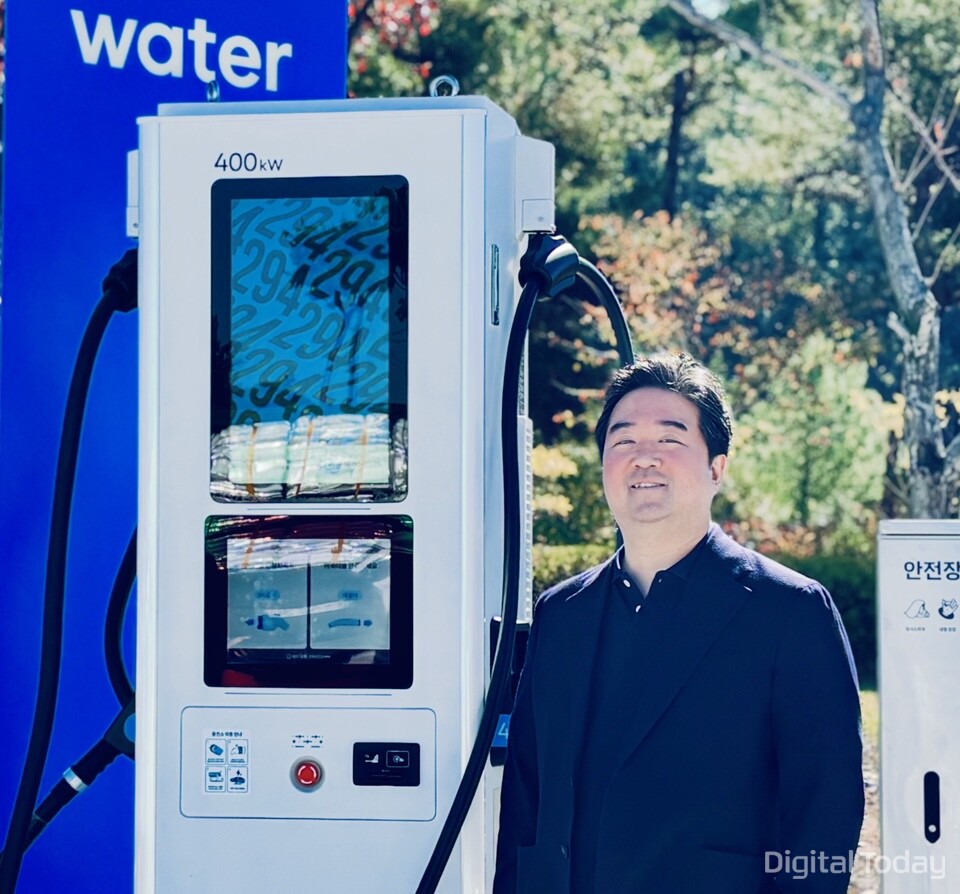
Water, the EV charging business unit of Bright Energy Partners, held a press briefing on Wednesday at Geumwang Rest Area on the Pyeongtaek-Jecheon Expressway, in the direction of Jecheon, and unveiled a charging station equipped with 400 kW ultra-fast chargers. Yoo Dae-won (유대원), Water's chief executive, said comprehensive operational capability and utilisation were important. "The core of Water's business is to operate well to build trust and lead to repeat visits," he said.
According to an analysis Water released last month, new construction of fast chargers has declined for a third straight year, but EV charging at highway rest stops during the Chuseok holiday period has risen 4.2 times in two years. As EV sales increased, highway traffic rose along the same trend and fed directly into rest-stop charging demand.
Demand has grown, but EV charging operators are in a situation where it is difficult to quickly increase investment. Operators secure rest-stop charging concessions through Korea Expressway Corp tenders, and contract periods are 10 years. Yoo said European road authorities sign 15 to 20-year contracts with charging operators. He explained that because charging demand and profits grow in the latter part of the contract period, trying to recoup investment within 10 years leaves operators with little choice but to cut costs, leading to a decline in build and operational quality.
Charging fees also cannot be adjusted by operators to match market demand. Because fees are an evaluation item in tenders, the public charging fee set by the Ministry of Climate, Energy and Environment effectively becomes the benchmark. Yoo said there is no formula or schedule for how fees are set, making it difficult for operators to forecast investment payback.
With the payback period and pricing constrained, Yoo cited turnover as the revenue condition. A single Water highway charger is used an average of 11 times a day, more than three times the rate of urban and roadside chargers at 3 times. Charging demand concentrates between noon and 3 p.m. He said revenue rises only if operators can serve the influx of vehicles at maximum output in a short time.
On highways in particular, rest stops are effectively the only place to charge, so accurate information leads to repeat visits. He explained that for operators who find it hard to set payback periods and fees on their own, a charging station users trust and seek out is a way to raise turnover.
Water installed 400 kW chargers to serve more vehicles during peak hours. Yoo said the investment reflects an expectation that vehicles will be able to accept higher output over the operating period. He added that some other operators view 400 kW as overinvestment for now.
Overseas, operational capability is already a key source of competitiveness for charging operators. Dutch charging operator Fastned has built trust that its chargers work without breakdowns, leading users to arrive with 10 to 20 percent battery remaining. The lower the remaining charge, the faster charging proceeds, allowing it to sell more electricity in the same time.
Yoo Dae-won, Water CEO: "Competition among EV charging stations is visibility, predictability and uptime"
Yoo said he sees such operational capability as the future competitive benchmark in the highway charging market. "It will not simply be output," he said, citing visibility, predictability and uptime. He said charging speed only needs to be above a certain level because users do other things such as eating while charging.
He said accuracy of this information becomes more important if agents later begin finding and guiding users to charging stations. Water maintains uptime, the share of time chargers can be used immediately without failures or inspections, at 99 percent. Yoo said operators need to accurately inform users whether there is a charger available when they arrive at a rest stop and reduce downtime from failures or inspections for users to keep coming.
Water plans to continue investing in rest-stop chargers despite pressure to recoup investment. Yoo said it costs more than 100 million won to install one rest-stop charger. Given that the annual volume won in Korea Expressway Corp tenders ranges from as few as 100 units to as many as 200 units, annual investment reaches 10 billion to 20 billion won. If it wins additional orders at privately operated rest stops, it spends more than 20 billion won a year on equipment investment alone.
Yoo said Water started as an in-house venture and is now a business unit, but it plans to be spun off into a separate company around next year. He said Water would operate well to build trust and drive repeat visits.
 Dae-geon Seok
d2dg@d-today.co.kr