
As funds concentrate in banks, parliament raised concerns at an audit that the contraction of savings banks and mutual finance institutions is worsening. Disputes also continued over the legal basis and supervisory procedures for total household loan volume management. Calls for institutional changes across the financial industry followed as issues including payment inconveniences for foreign tourists, the burden of Apple Pay fees and restrictions on domestic simple payment services were also raised.
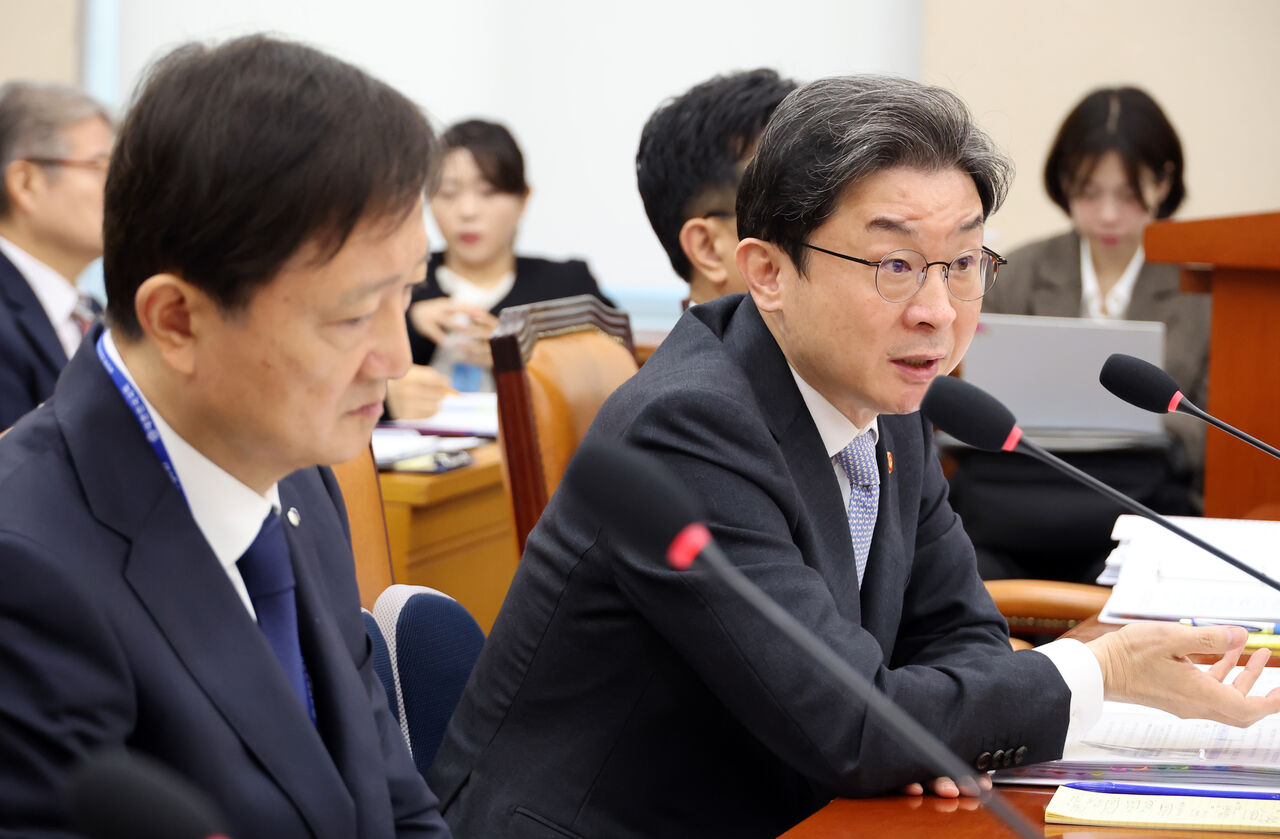
At a comprehensive financial sector audit by the National Assembly's Political Affairs Committee on Wednesday afternoon, lawmakers continued to question funding imbalances between banks and the non-bank sector, how household lending is regulated and digital payment infrastructure. Financial authorities said they would examine structural gaps across financial sectors and review how total loan volume management works and measures to improve the payment environment.
◆ Funds concentrate in banks... polarisation in savings banks and mutual finance deepens
Lawmakers also raised concerns that gaps in assets and profitability between banks and the savings bank and mutual finance sector are widening.
Data presented by Democratic Party lawmaker Yoo Dong-soo showed banks' total assets expanded to 4.3 times those of savings banks and mutual finance institutions as of end-June from 3.8 times as of end-2023. The gap in net profit widened to 15.8 times as of end-2024 from 12.3 times as of end-2023.
The gap also widened in lending and deposits. The difference in loan books between banks and savings banks and mutual finance institutions expanded to 3.1 times as of end-June from 2.9 times as of end-2023. Over the same period, the deposits gap increased to 2.9 times from 2.6 times.
Lawmakers also pointed to funds concentrating in banks rather than flowing into the non-bank sector even after the deposit insurance cap was raised to 100 million won from 50 million won in September 2024.
Figures presented at the audit showed deposits at savings banks and mutual finance institutions fell by 29.5 trillion won over the past year. By contrast, bank deposits rose by 166.8 trillion won to 2,924 trillion won from 2,758 trillion won.
Deposit rate competitiveness also appeared to have weakened. An analysis said deposit rates at mutual finance institutions were lower than those of banks from December 2025 to June 2026.
Lawmakers also raised the soundness of the non-bank sector. They cited figures showing the number of credit union units in capital impairment rose to 216 as of end-June from 100 in 2023, while the number of Saemaul Geumgo units increased to 227 from 36 over the same period.
Financial Services Commission chairman Lee Eok-won (이억원) explained that bad property project financing exposures are affecting how the non-bank sector manages funds and attracts deposits. As non-performing assets increased, it became harder to find where to deploy newly secured funds, he said.
He replied that there is a need to strengthen management through soundness regulations while improving business models by sector. He also said authorities would review measures to redefine the roles of banks and the non-bank sector and ease structural imbalances.
Financial Supervisory Service governor Lee Chan-jin (이찬진) also explained that he would look at Japan's example of reorganising the role of regional and small financial institutions and discuss improvement measures with the Financial Services Commission.
◆ 'Shadow regulation' dispute over total loan volume management... legal basis and supervision procedures at issue
Lawmakers raised issues over the legal basis for household loan volume management and the financial authorities' administrative guidance procedures.
Ruling People Power Party lawmaker Cho Jung-hoon questioned whether the Financial Services Commission can limit individual banks' loan caps and impose disadvantages based only on broad financial market stability and supervisory authority. He raised the issue after the commission presented the Act on the Establishment of the Financial Services Commission and the Banking Act as the basis for total household loan volume regulation.
Authorities explain they manage overall loan volumes through voluntary consultations with banks, but lawmakers said in practice disadvantages are applied by cutting next year's loan limits for banks that exceed targets.
In another line of questioning, lawmakers also raised that 7 banks that exceeded last year's household loan growth targets were subjected to measures that deducted the excess from their loan limits this year. The Financial Supervisory Service said the measures were based on voluntary consultations with banks.
At the audit, lawmakers criticised the approach, saying it is effectively no different from mandatory regulation for the Financial Supervisory Service, which holds supervisory authority, to set targets and impose disadvantages on banks that fail to meet them.
The procedural appropriateness of financial administrative guidance was also at issue. Lawmakers said the Financial Supervisory Service is delivering guidelines and disadvantage measures verbally to bank officials.
They also asked whether procedures such as soliciting opinions, deliberation and written notification on administrative guidance were sufficiently carried out. They also raised that past administrative guidance on mortgage loans had validity periods, but the current volume management approach has no clear end point.
Lawmakers also cited cases of consumer inconvenience caused by total loan volume management. They presented cases in which applications for 50 billion won in balance payment loans for newly built apartments near Maegyo Station in Suwon closed in a short time, and in Pyeongtaek only about 20 percent of households among 1,700 were able to obtain loans.
Financial authorities said total volume management is necessary as household debt is a major risk factor in the domestic financial market. They also explained that it is difficult to apply uniform regulatory standards because conditions differ by bank.
They also said they would review the legal and procedural issues of total volume management and examine whether they can supplement the current management approach.
◆ Apple Pay fees and NFC opening... calls to improve payment infrastructure
In digital payments, lawmakers raised issues of payment convenience for foreign tourists and the user environment for domestic simple payment services.
Data presented by Democratic Party lawmaker Kim Yong-man showed spending by South Koreans using cards overseas last year was 33 trillion won, 13 trillion won more than foreigners' card spending in South Korea of 20 trillion won.
Lawmakers also cited that payment-related problems account for a significant share of inconveniences raised by foreign tourists. They said 1 in 4 inconvenience reports filed by foreign tourists with the Korea Tourism Organization last year concerned payment issues.
Lawmakers pointed to fees and payment infrastructure costs as reasons Apple Pay has spread slowly in South Korea. Apple Pay's partner card issuer in South Korea currently remains limited to Hyundai Card, and fees paid by card issuers to Apple were about 0.15 percent of payment amounts, about five times the level in China.
They also cited additional costs in card registration and payment processes and the burden of rolling out near-field communication (NFC) terminals as factors making it difficult for other card issuers to introduce the service.
Lawmakers also raised limits on access to the iPhone's NFC payment functions. They called for improving the environment so domestic simple payment services such as Naver Pay and Toss Pay can make payments using the iPhone's NFC functions.
Some lawmakers also argued the government should more actively support expanding payment infrastructure to improve convenience for foreign tourists. They said South Korea should refer to overseas cases such as China and Europe and prepare for new technologies including QR payments and biometric authentication payments.
The Financial Services Commission said Apple Pay fees are an area for voluntary agreement between businesses, but it would examine improvement measures so foreign tourists can conveniently use a variety of payment methods.
It also said it would review issues including NFC opening, including the role of competition authorities, and discuss what can be supported institutionally by financial authorities.
The Financial Supervisory Service also explained it would review the possibility of building public infrastructure related to new payment technologies such as facial recognition payments, and consult with the Financial Services Commission on the direction of improvements, including fees.
 Lee Ji-young
ljy@d-today.co.kr