
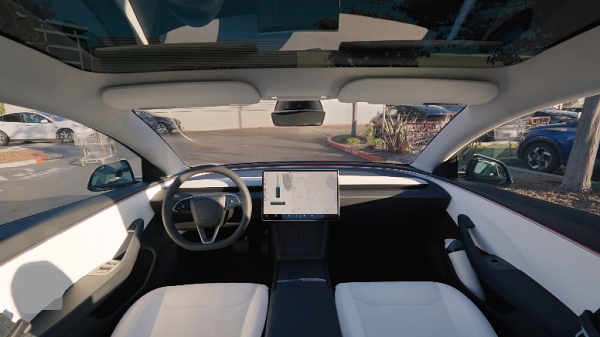
Tesla said 75 percent of its North America new vehicle deliveries last quarter included its driver-assistance software FSD. With global FSD subscribers rising to 1.74 million, a software revenue model combining paid subscriptions and vehicle sales is emerging as a core business for Tesla.
InsideEVs reported on Oct. 21 that Tesla disclosed in a recent earnings presentation that 75 percent of North America new vehicle deliveries included FSD. That was up 20 percentage points from 55 percent in the second quarter.
FSD is Tesla's driver-assistance software and is currently offered in a form that requires driver supervision. The monthly subscription fee is $99 (about 130,000 won). Given that many consumers in the auto industry are reluctant to pay monthly subscriptions for additional features, the high attach rate in new vehicle deliveries is drawing attention.
Tesla explained that FSD is a key factor underpinning recent vehicle purchase demand. It argued that the competitiveness of its self-driving software contributed despite the largest level of order backlog in the past 4 years.
Ashok Elluswamy (애쇼크 엘루스와미), Tesla's vice president of AI software, said all delivered vehicles include a free 1-month FSD subscription. He said customers continue subscribing even when a free trial period is offered.
Tesla said the 1.74 million global FSD subscribers include not only monthly subscribers but also customers who bought the software outright. The company said this time that the subscription share itself exceeded 50 percent, rather than a combined basis of subscriptions and one-time purchases.
Based on this, if about half of total subscribers, or 875,000 people, are assumed to be subscribers paying $99 a month, monthly subscription revenue would be about $86.6 million (about 114.6 billion won), or about $1.04 billion (about 1.38 trillion won) annually. It said the figures are estimates assuming subscriber counts and the subscription fee are maintained, and actual revenue could differ.
The market is seeing the figures as an example showing Tesla's software-focused business strategy. Tesla has gone beyond vehicle sales and has grown self-driving functions into a business that generates recurring revenue. The structure is to secure FSD users during the new vehicle sales process and then earn additional revenue through subscription fees.
Still, it is difficult to judge the business' profitability based on subscriber scale alone. Tesla did not disclose the average retention period or churn rate for FSD subscribers. How many customers continue paid subscriptions after the free trial ends is a key variable that will determine long-term revenue. The company said it will disclose related indicators such as churn rates in the future, but it is taking a cautious stance regarding approval procedures in overseas markets.
Challenges also remain for commercialisation. FSD currently comes with the condition that driver supervision is required. Tesla signalled it could be ready by next summer to provide buyers with FSD that does not require driver supervision. The feature is expected to be offered on a limited basis only in markets approved by regulators and in vehicles equipped with the latest hardware.
Tesla is also pushing a plan to incorporate customer vehicles into its robotaxi network. If FSD technology advances and services expand as planned, software subscriptions and autonomous driving services could become new revenue sources after vehicle sales.
Ultimately, the yardsticks to gauge sustained growth of the FSD business are expected to include not only subscriber numbers but also the paid conversion rate and retention rate, and whether regulators approve it in overseas markets. With the FSD attach rate rising in North America new vehicle deliveries, attention is on whether Tesla can link it to long-term recurring revenue and an expansion of autonomous driving services.
 Jinju Hong
hongjj@d-today.co.kr