
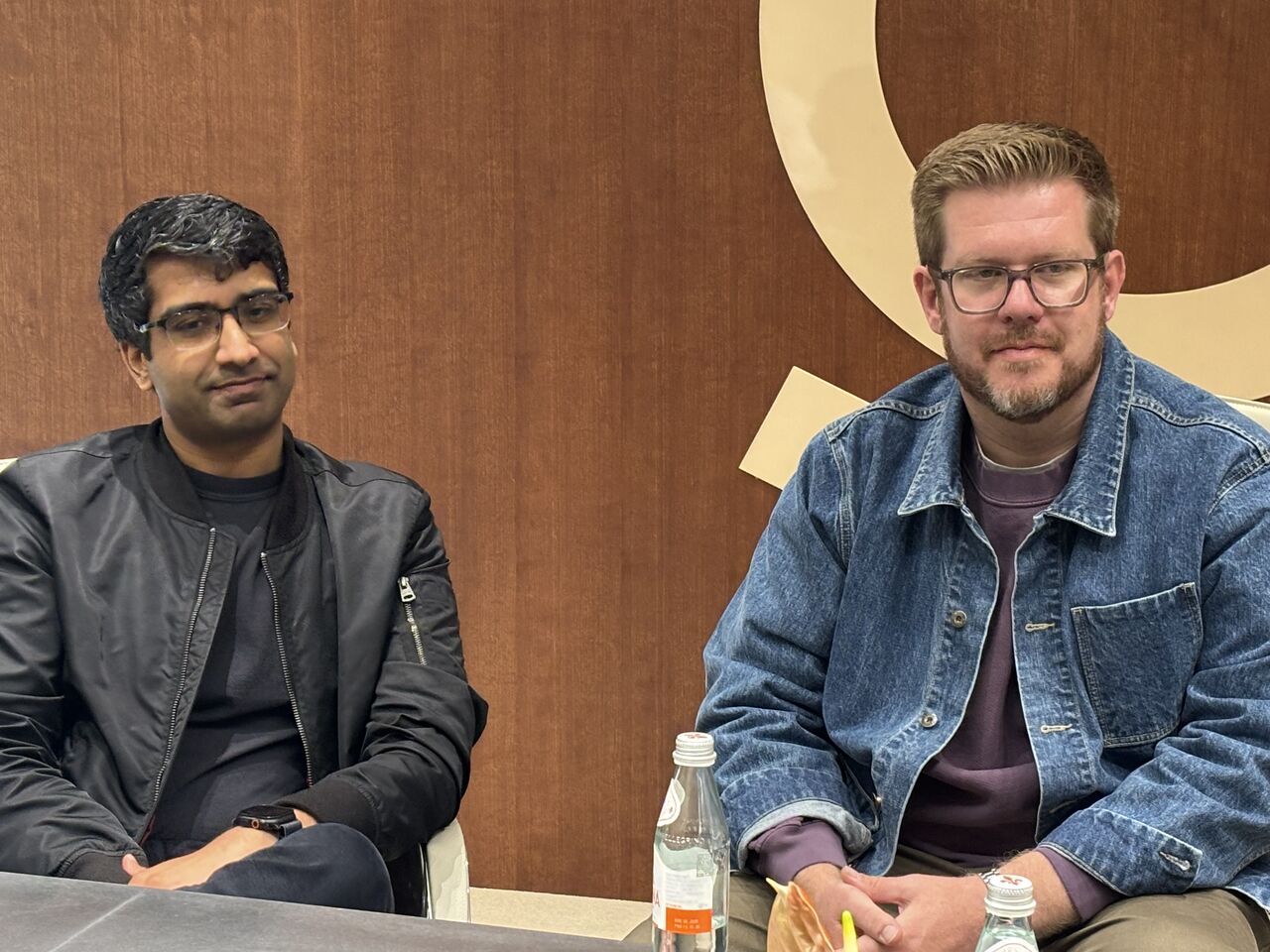
[DigitalToday reporter Chi-gyu Hwang] "Sovereign AI is not about which model you use. It is about who holds decision-making authority over the entire tech stack."
Palantir chief architect Akshay Krishnaswamy (악샤이 크리슈나스와미) and Chad Wahlquist (채드 월퀴스트), head of AI architecture, met reporters on Wednesday at a pop-up store event in Seoul held under the theme of sovereignty and defined sovereign AI that way.
The two said sovereign AI means customers must have choice at every layer, including data, computing, deployment location, models and business processes. They repeatedly stressed that "Palantir does not control any data" and said that without such guarantees, European governments or Swiss banks would not have trusted Palantir.
On setting the pop-up store theme as sovereignty, they explained that South Korean companies have a particularly strong will to secure know-how they have accumulated themselves rather than hand it over to external AI labs.
Palantir is known for its ontology technology.
According to the two, ontology can be summed up as a digital twin that directly mirrors a company’s operations.
Unlike a knowledge graph that only connects data, ontology includes business logic, executable actions, approval authority and security. In their words, ontology is "a shared world used by people and AI together."
They said the key to ontology is solving problems in critical operations. They said what matters is whether it enables real use of AI in core work such as shipyard schedule management, semiconductor production and supply chain management.
Palantir also stressed that South Korea is an important market. It said South Korea ranks third globally in Palantir merchandise sales. It is also speeding up on-site support for local companies through Palantir Korea.
The two cited three points as key value of the South Korean market for Palantir: a focus on core industries such as telecommunications, semiconductors and shipbuilding; having experienced the value of the U.S.-South Korea alliance and national defense over 50 to 60 years; and a deep pool of technical talent.
They also stressed that it is more important to use AI that is already available properly than to wait for better AI such as artificial general intelligence. They said, "What a factory needs is not a PhD but a skilled worker," and added that there is a big opportunity to build specialised models using shipbuilding and manufacturing field knowledge that AI still cannot handle well.
Palantir is also known for deploying forward deployed engineers, or FDEs, directly to customers to run projects together. Recently, several companies other than Palantir have also begun setting up FDE organisations for AI transformation, or AX, projects.
They also had much to say on that. They said Palantir FDEs are resident at customer companies and deliver results, while also holding authority to fix products together with development teams in California, New York and London. They said that while FDEs may be a role that can be done without at other companies, Palantir as an entire organisation revolves around FDEs.
They said other companies use the term FDE, but in many cases decisions about products are made by a central organisation rather than on the ground. They said that even if the title is the same, the work is closer to consulting in practice.
On AI model developers joining the race to build FDE teams, they said FDE work must be designed backward from the results customers want, and that if the aim is to get customers to use one more of a company’s products, it serves company interests rather than customers. They said under that approach, it will not work properly whether there is 1 FDE or 10,000.
 Chi-gyu Hwang
delight@d-today.co.kr