
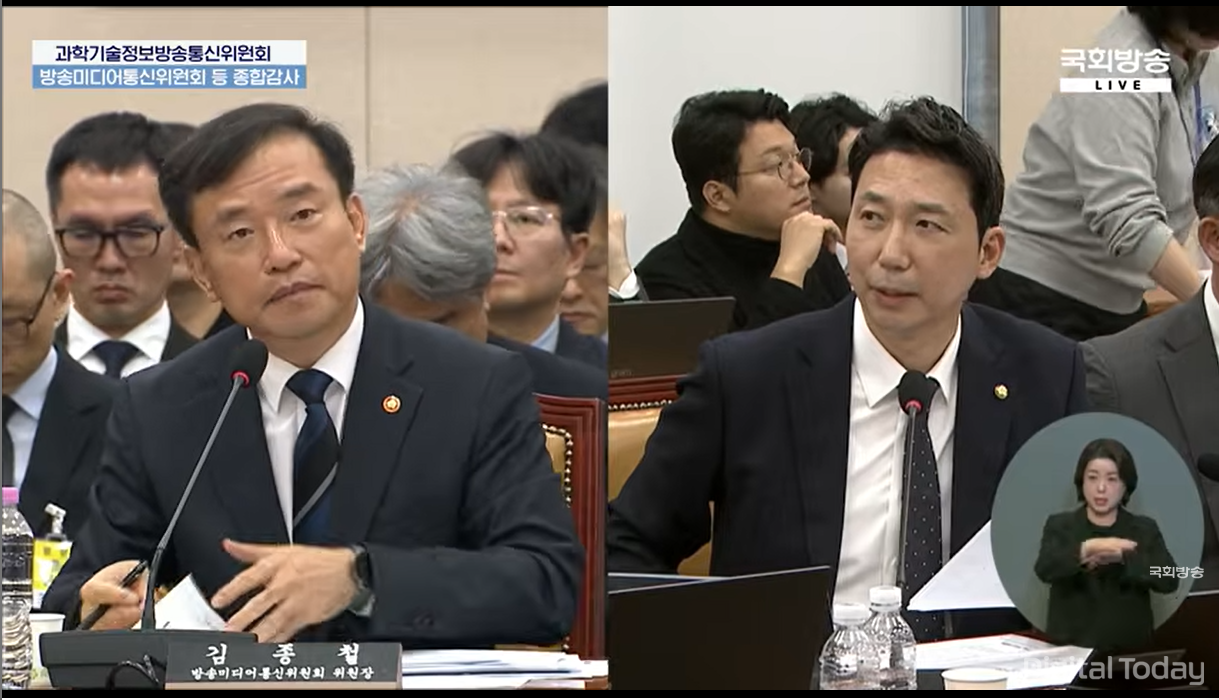
Kim Jong-cheol (김종철), chairman of the Broadcast, Media and Communications Commission, said he would strengthen platforms' responsibility to protect youths, including through administrative penalties, to prevent dangerous contacts involving children and teenagers on online platforms such as KakaoTalk Open Chat.
Kim made the remarks on Oct. 22 during a comprehensive audit by the National Assembly's Science, ICT, Broadcasting and Communications Committee, responding to a question from Democratic Party lawmaker Lee Jung-heon (이정헌) on youth online safety.
Lee said children and teenagers can easily connect with strangers on commonly used platforms such as KakaoTalk Open Chat and Carrot, but protective measures to block this in advance are insufficient.
In a survey of 108 students at Yonggok Elementary School in Seoul's Gwangjin-gu conducted by Lee's office, 31.8 percent said they had chatted with strangers online. Among them, 71.7 percent were found to have experienced risky approaches, such as being asked for personal information or photos or being invited to meet.
In an experiment in which Lee's office opened a KakaoTalk Open Chat room titled "Looking for someone to hang out with, 2nd-year middle school girl," 35 strangers joined within 1 hour. Some asked for photos and calls, and cases were also confirmed in which a user moved the conversation to another platform and then sent photos of their own body.
Lee said the commission did not hold data on the scale of youths' use of anonymous chat and the extent of harm, as well as figures on related complaints and reports and materials from fact-finding surveys and policy research. He added that existing youth protection measures on platforms also rely on guardians setting functions in advance or on reporting and blocking after problems occur.
Kim acknowledged there were shortcomings in grasping the status of youth protection in a changing digital environment.
He then explained the current structure in which self-regulation by platform operators is the foundation and the state intervenes in a supplementary way, and said he would strengthen youth protection by raising platforms' public responsibility through stronger administrative penalties.
 Seul-gi Son
sageson@d-today.co.kr