
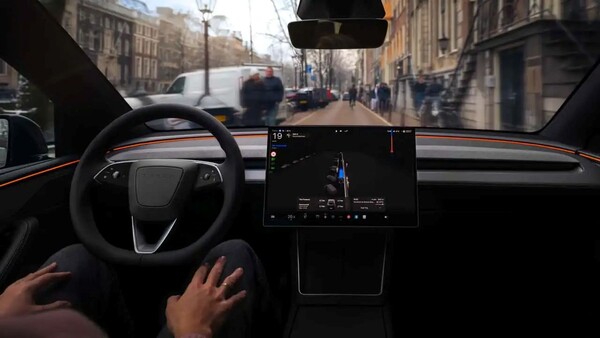
[DigitalToday reporter Jinju Hong] Tesla has set the second quarter of 2027 as the time to introduce unsupervised Full Self-Driving (FSD) for customer-owned vehicles. The model is limited in that it is not designed for personal cars to drive anywhere without driver intervention. Owners would need to place their vehicles into Tesla’s robotaxi network. Critics say there is a gap between what customers expecting personal full self-driving have anticipated and the actual rollout plan.
Electrek, an electric-vehicle outlet, reported on Oct. 21 that Tesla AI chief Ashok Elluswamy (아쇼크 엘루스와미) set the second quarter of 2027 as the target for introducing unsupervised FSD for customer vehicles during a conference call on third-quarter 2026 results. The question was one of the most frequently raised by Tesla retail shareholders and received support from about 1.1 million shares.
The plan differs from typical personal-use autonomous driving. Elluswamy explained that in the first stage it would not be a model where, through a software update alone, a personal vehicle can drive unsupervised to any desired destination anywhere. Instead, he presented a model in which an owner places the vehicle into a robotaxi fleet managed by Tesla.
That means unsupervised driving for customer vehicles would be limited to areas where Tesla robotaxis already operate. Even if customers own their cars, it would be difficult to use unsupervised FSD freely outside operating zones and conditions set by Tesla.
Tesla robotaxis currently operate in 6 major U.S. metropolitan areas, but the actual operating range is limited to certain zones rather than entire cities. In Miami, the service is focused on some sections around West Miami, Doral and Sweetwater. Orlando and Tampa, which began service in July 2026, also operate based on limited driving zones.
There are also constraints on driving conditions. The robotaxi service operates mainly on low-speed roads, largely avoids highways and limits difficult sections. As a result, even if unsupervised FSD is applied to customer vehicles, the roads and areas where it can be used are likely to be limited in the early stages.
In California, regulatory barriers also need to be addressed. Tesla’s service in the Bay Area has not yet reached the stage of unsupervised driving. Under California rules, a safety driver must be in the vehicle. Tesla has reportedly not submitted required data to the California Department of Motor Vehicles for autonomous driving systems beyond Level 2.
The scale of robotaxi operations also remains a challenge. Tesla said cumulative unsupervised robotaxi mileage reached about 2 million miles as of the end of the third quarter of 2026. That figure was tallied one month after the Cybercab joined the Austin robotaxi fleet.
Still, assessments say the number of fully driverless Tesla vehicles operating on real roads remains limited. Third-party tracking data from this spring introduced by Electrek estimated the number of fully driverless vehicles at the level of several dozen. Analysts say there is still a gap between Tesla CEO Elon Musk’s plan, which has emphasised scaling up large autonomous driving services, and the actual operating scale.
The announcement also contrasts with earlier commitments Tesla has presented to FSD buyers. Tesla has long suggested expectations that software updates would ultimately enable vehicles to drive themselves across a range of road environments. Musk told investors in July 2025 that unsupervised FSD could be offered for personal use in certain regions by the end of that year. In 2024, he also said he would be surprised if unsupervised autonomous driving was not achieved the following year.
Vehicle hardware is another variable. Some customers who bought vehicles equipped with Hardware 3 (HW3) have reportedly been told that the vehicles’ computers cannot run unsupervised FSD. However, a concrete hardware upgrade plan for existing vehicles has not yet been clearly presented. If the introduction of unsupervised FSD is delayed, dissatisfaction among existing buyers could grow.
Ultimately, Tesla’s plan for the second quarter of 2027 is closer to placing vehicles into Tesla’s managed robotaxi network than to a stage where all customers can freely use full self-driving in their own cars. For actual commercialisation, Tesla will need to resolve issues including expanding operating zones, validating safety, responding to region-by-region regulations and hardware compatibility for existing vehicles.
The key question ahead is how quickly Tesla can expand the robotaxi operating area and broaden customer vehicles’ unsupervised driving from a limited service into a practical personal mobility option. Attention is also on whether the second-quarter 2027 target will lead to an actual service launch.
 Jinju Hong
hongjj@d-today.co.kr