
South Korea's financial authorities said they will continue to check exposure and risk management after criticism that some funds in integrated investment accounts (IMA) introduced to expand productive finance have been put into overseas private credit.
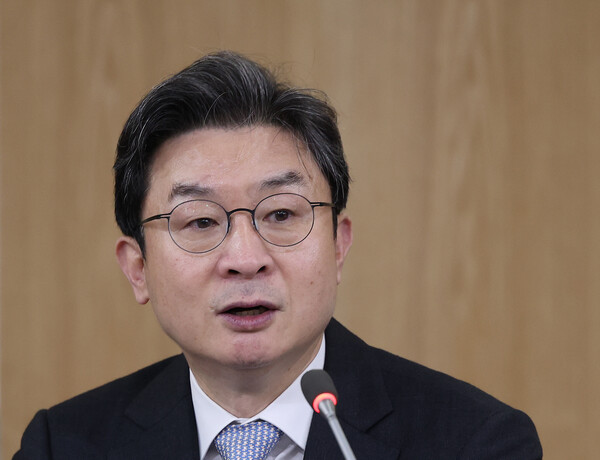
Financial Services Commission Chairman Lee Eok-won (이억원) said during a comprehensive parliamentary audit of the National Assembly's Political Affairs Committee on Wednesday that regulators are continuing to check with the Financial Supervisory Service how large the exposure is and how it is being managed.
Kim Hyun-jung (김현정), a lawmaker from the Democratic Party, said IMAs were allowed to supply funds to domestic companies and venture capital as productive finance, but some funds are in fact being invested in overseas private credit.
She cited Korea Investment & Securities' IMA as an example. According to Kim, the share of overseas private credit investments in Korea Investment & Securities' IMA No. 1 and No. 2 products was 28.7 percent and 24.5 percent, respectively.
An IMA is an account in which a securities firm manages funds received from customers in corporate finance-related assets and pays returns. It was designed to require securities firms to invest more than 70 percent of the funds raised in corporate finance-related assets, in exchange for taking on the obligation to pay back principal at maturity.
The share of overseas private credit within Korea Investment & Securities' overall IMAs fell as the amount raised increased, but the investment balance itself did not change significantly.
Kim said the share of overseas private credit fell to 15.8 percent at the end of August from 26.9 percent at the end of January, but that was largely due to an increase in total IMA fundraising. The outstanding balance of overseas private credit fell only 11.4 billion won to 498.4 billion won from 509.8 billion won over the same period.
Korea Investment & Securities has said overseas private credit is a 'bridge asset' used to manage funds until domestic investment destinations are secured. Kim said, however, that based on subsequent management conditions it is hard to say the size of overseas private credit investments has fallen sufficiently.
Overseas private credit is an investment approach in which private funds lend directly to companies instead of banks. It can offer relatively high expected returns, but it can be difficult to quickly turn assets into cash and redemptions may be restricted during market instability, making liquidity management important.
As the overseas private credit market grows rapidly, the need to manage related exposure and asset soundness at domestic financial companies is also increasing.
Lee said overseas private credit has surged overall, creating a situation that requires risk management, and that he would review the individual company case mentioned and report separately.
The audit also addressed the securities industry's dual listing issue. Lee made clear that plans to list Solidigm, SK hynix's U.S. unit, would fall under the current dual listing guidelines.
Asked whether Solidigm's U.S. listing would constitute a dual listing, Lee said it would and would be subject to the dual listing guidelines. He said SK Square and SK hynix, as parent companies, must fulfill five key obligations: assess shareholder impact, prepare shareholder protection measures, communicate with shareholders, conduct a board resolution for or against, and make disclosures.
He also confirmed the same standards apply to listings on overseas exchanges. Lee said the dual listing guidelines apply whether the listing is overseas or domestic.
Lee said Solidigm has not officially announced a listing or confirmed specific plans, and he avoided giving a direct answer on obligations such as submitting a domestic securities registration statement.
 Oh Sang-yup
yub@d-today.co.kr