
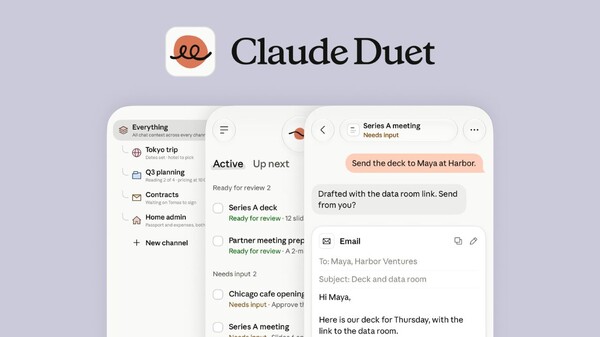
Anthropic unveiled its personal artificial intelligence (AI) agent Claude Duet, joining the race for proactive AI assistants led by Meta and OpenAI.
On Oct. 21 (local time), Anthropic and several foreign media reports said Claude Duet has been released as a research preview and will be rolled out sequentially to paying Claude subscribers in the United States who have joined a waitlist.
Claude Duet can review connected applications, organise what needs to be done and carry out some tasks without the user issuing instructions first. Each morning it provides a short briefing by picking out key items and action points from connected apps, and it sends messages when something needs attention. Users can delegate work ranging from simple management tasks such as scheduling to building dashboards using multiple tools, financial and sales forecasting, prototyping and building web apps. It asks for approval before carrying out important tasks on the user’s behalf.
The service runs on Anthropic’s AI model Claude Opus 5.5. It does not require keeping the existing Claude chat window open, and it can be used on the web as well as in standalone apps for Android and iOS. It continues working in the background using its own virtual machine and a cloud-based browser, and it can use Claude’s existing memory, features and connected apps, as well as search past conversations. Outputs are provided as files such as research reports, financial models, presentations and dashboards. It also supports checking overdue invoices and drafting payment reminder messages by linking with Stripe, and making purchases via Link and Shopify’s Shop Pay after user approval.
Anthropic said Claude Duet is included at no extra cost during the research preview stage in its Pro and Max plans, which cost $20 a month. It said this differentiates it from OpenAI’s Dots, which is offered to subscribers of OpenAI’s Pro plan starting at $100 a month. Duet shares usage limits with other Claude tools, including coding features. Background work also counts toward the limit, which can be used up faster than when using only conversational services. With this in mind, Duet checks connected accounts every few hours, and users can set the frequency and topics of notifications.
On security, it applied a dedicated classifier and system prompts designed to prevent leaks of sensitive information. Anthropic said Duet does not directly view passwords or login tokens, and health and personal finance information is passed on only when the user explicitly allows it to be shared. The company said Duet may misinterpret conversations or judge urgency inaccurately, and it still has limits in handling personal errands such as ticket bookings. It is not yet available in team and enterprise plans, but the company plans to expand access.
Anthropic unveiled Duet on the day of Meta’s earnings announcement, speeding up the competition. Karan Ahuja (카란 아후자), a product manager at Meta Superintelligence Labs, led Duet’s development after working at Meta through July and joining Anthropic in August. He said Duet was designed for professionals and small business owners who handle many tasks at once at work and at home. Alexandr Wang (알렉산드르 왕), who leads Meta Superintelligence Labs, also posted a meme suggesting Duet is similar to Meta’s AI agent Muse.
Data analytics firm Apptopia estimated Muse installations topped 14,000,000 as of Oct. 21. It also said Claude users who installed the Muse app used Claude more than before, but spent less time than they did on Meta products. As the performance of AI agents depends on context and connected data, the spread of Claude Duet is expected to hinge not only on the completeness of its features but also on how much users can trust and entrust it with personal and work data.
 Seung-a Yoo
ysah@d-today.co.kr