
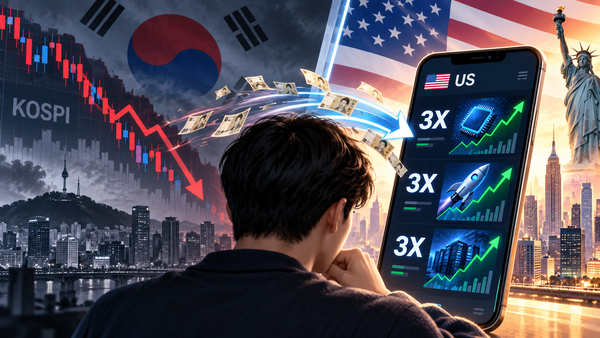
[Digital Today reporter Sangyeop Oh (오상엽)] With the domestic stock market swinging sharply day after day, Korean investors appear to be continuing high-risk leveraged investing in the U.S. market.
Data from the Korea Securities Depository’s SEIBro showed that from Sept. 18 to Oct. 21, the top foreign securities purchase settlement by Korean investors was Direxion Daily Semiconductor Bull 3X Shares ETF (SOXL).
SOXL purchase settlements totalled $6.03 billion (about 8 trillion won). Sales settlements during the same period were $3.27 billion, leaving net purchase settlements of $2.76 billion (about 3.7 trillion won).
Buying was concentrated over a short period as volatility in domestic and global stock markets increased recently. From Oct. 15 to Oct. 21, SOXL purchase settlements were $2.83 billion (about 3.8 trillion won), and net purchase settlements were $2.74 billion, a level similar to the cumulative net buying for the month.
SOXL is designed to track three times the daily return of a U.S. semiconductor-related index. A sharp rebound in the semiconductor sector can significantly boost returns, but losses are magnified in the same way if it moves in the opposite direction.
Demand also emerged for leveraged exposure to gains in the Korean stock market. Direxion Daily MSCI South Korea Bull 3X Shares ETF (KORU), listed in the United States, ranked second among all foreign securities in Korean investors’ purchase settlements over the past month at $605.1 million (about 800 billion won). Net purchase settlements were $324.43 million.
Even in just the past week, KORU saw $290.95 million in purchases to rank second behind SOXL. Net purchase settlements also reached $243.44 million. That suggests many investors used triple-leveraged products in the U.S. market rather than investing directly on expectations of a short-term rebound in Korean stocks.
Leveraged products linked to Nasdaq gains also appeared near the top of the list. Over the past week, purchase settlements for ProShares UltraPro QQQ (TQQQ), which tracks three times the daily move of the Nasdaq 100, were $154.07 million, and $79.09 million was bought in the two-times product ProShares Ultra QQQ (QLD).
Not only bullish bets but also triple-inverse products wagering on semiconductor weakness are being used for short-term trading. Rather than making a long-term call on the sector’s direction, trading appears to be continuing as investors switch between leveraged and inverse products to target short-term volatility during sharp swings.
In contrast to such overseas leveraged investing, there are also signs that short-term risk money is declining in the domestic stock market.
Data from the Korea Exchange showed that from Oct. 15 to Oct. 21, retail investors were net sellers of 574.8 billion won in the KOSPI market. Foreign investors also sold a net 3.135 trillion won over the period, while institutions bought a net 504.0 billion won.
Stock market cash on the sidelines and the scale of leveraged retail borrowing also declined. Investor deposits fell by about 12.5 trillion won to 92.091 trillion won on Oct. 19 from 104.638 trillion won on Oct. 1. Margin loan balances also fell by about 2.4 trillion won over the same period to 30.675 trillion won from 33.306 trillion won.
Volatility in the domestic stock market remains high. The KOSPI slid as much as 3.73 percent on Oct. 20 to 5,552.74, then rebounded 3.29 percent on Oct. 21 to 5,735.66. Investor sentiment is swinging sharply day to day, with a buy-side circuit breaker triggered during intraday trade.
The industry sees demand concentrating in leveraged products seeking big gains over a short period, rather than trying to predict direction, as semiconductor and artificial intelligence-related stocks at home and abroad swing sharply.
It also says trading tends to concentrate in periods of rising volatility because the U.S. market has a wider range of two- to three-times leveraged ETFs than Korea.
Still, leveraged ETFs do not aim for a simple two- to three-times multiple of long-term returns, but a multiple of daily returns. If markets repeatedly swing sharply, daily rebalancing and compounding effects can cause long-term performance to differ significantly from a simple multiple of the underlying index’s move. For investors using the won, changes in the won-dollar exchange rate, as well as stock price moves, also act as an additional variable in returns.
An investment industry official said, "Korea’s stock market has fallen sharply in succession and volatility is high, which is tiring, while there seems to be a perception that the U.S. market is relatively stable," adding, "Even so, expectations for Korean stocks remain, and there is a tendency to approach triple-leveraged products as a low-price buying concept."
The official added, "With uncertainty remaining in the market over the AI bubble argument and global companies’ earnings scheduled, cautious investment in leveraged products is required."
 Sangyeop Oh
yub@d-today.co.kr