
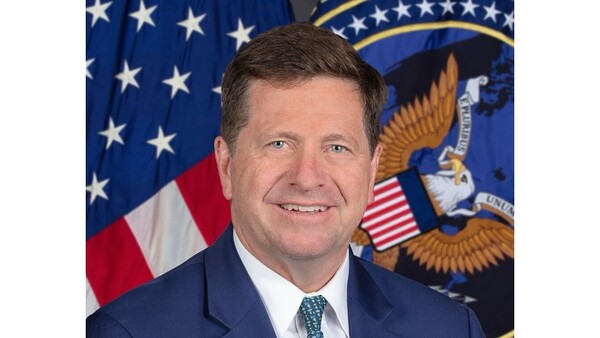
[DigitalToday reporter Hyunwoo Choo] U.S. President Donald Trump is considering appointing Director of National Intelligence Jay Clayton (제이 클레이턴) as a new AI czar. Cointelegraph, a blockchain media outlet, reported on Oct. 3 local time that Clayton could keep his DNI post while taking on AI innovation and development and oversight of technology firms' self-regulation.
Trump has been pursuing plans to create an "AI Force" modeled on the Space Force and to establish an AI czar post. He has also said he will manage the AI industry but will not add new regulations that could slow innovation.
Trump met heads of AI and technology companies at the White House on Sept. 30 and had them sign a new pledge to manage their own AI models and development. The personnel review also aligns with a shift toward industry self-regulation rather than government regulation.
Clayton served as chairman of the Securities and Exchange Commission in Trump's first administration and later as acting U.S. attorney for the Southern District of New York. He became director of national intelligence in July after Senate confirmation. At his confirmation hearing, he described AI as a game changer and an opportunity, but also a threat.
The White House has not made an official announcement. CBS News reported that Clayton is the leading candidate for the role, but a White House official said any related announcement is for the president to make and that current reports are speculation.
The discussion also ties into a U.S. debate over moderating the pace of AI development. Anthropic CEO Dario Amodei said that unchecked development could allow AI to outpace our ability to understand and control it, and he proposed a three-step plan. Anthropic later selected Accenture as an in-house evaluation body.
OpenAI CEO Sam Altman and SpaceX CEO Elon Musk responded positively to Amodei's proposal. Nvidia CEO Jensen Huang countered that such regulations are not necessary.
David Sacks, who served as the crypto and AI czar in the Trump administration, completed a 130-day term in March. Under U.S. rules, a special government employee can work only up to 130 days in a 12-month period. Sacks said he would continue advising on technology policy as co-chair of the President's Council of Advisors on Science and Technology.
 Hyunwoo Choo
cookinpapa@d-today.co.kr
Hyunwoo Choo
cookinpapa@d-today.co.kr