
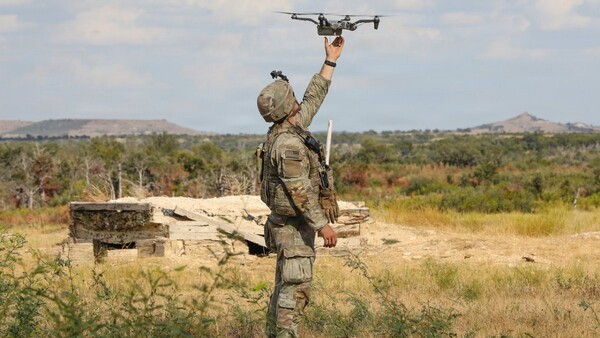
[DigitalToday reporter Jae-won Choi] The U.S. War Department (Defense Department) is seeking to establish a four-star combatant command dedicated to autonomous weapon systems such as drones, AI and robots. If it launches as planned, it would add a 12th command to the 11 existing U.S. combatant commands.
On Oct. 1 (local time), Cryptopolitan and others reported that U.S. War Department Secretary Peter Hegseth (피트 헤그세스) on Sept. 30 unveiled the concept for an "Autonomous Warfare Command" (Autonomous Warfare Command·AutoWarCom) at Marine Corps Base Quantico in Virginia. The idea is to bring the development and adoption of drones, robots and AI-based autonomous systems under a permanent command structure, on the view that existing acquisition and procurement systems cannot keep pace with the speed of change in warfare technology.
According to the War Department's "Project Agincourt" plan, AutoWarCom is designed as a function-based combatant command led by a four-star officer. It would have personnel, budget and weapons acquisition authority, and would be tasked with integrating unmanned and autonomous system forces scattered across the services. The target launch date is Oct. 1, 2027. Formal activation would require legislation by Congress.
Preparations for establishing the command will be handled by the War Department's unmanned systems portfolio organization. Owen West (오언 웨스트), head of the Defense Innovation Unit (DIU), and Max Strasiser (맥스 스트라시서), a Navy special warfare operator, will lead Project Agincourt in a "CEO·COO partnership" model and are set to draw up a detailed execution plan and phased timeline within 30 days. A four-star commander to lead AutoWarCom will be appointed separately.
The move comes amid the rapid spread of low-cost unmanned systems seen in the Ukraine war and elsewhere. The War Department says it must secure autonomous systems that can be deployed at scale alongside expensive existing weapons. Concerns have also been raised that international norms and control mechanisms are lacking compared with the pace of the spread of military AI. Steve Feldstein (스티브 펠드스타인) of the Carnegie Endowment for International Peace warned in congressional testimony last month that the fast spread of military AI and gaps in norms could increase security and human rights risks.
 Jae-won Choi
ittt_0801@d-today.co.kr
Jae-won Choi
ittt_0801@d-today.co.kr