
The domestic AI semiconductor performance metric K-Perf will be used for the first time to verify a user organisation’s adoption of AI semiconductors (NPUs).
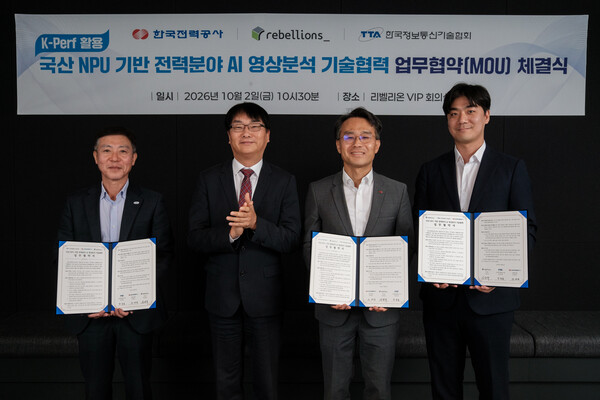
The Ministry of Science and ICT attended a signing ceremony on Thursday at Rebellions headquarters for a business cooperation agreement between Korea Electric Power, Rebellions and the Telecommunications Technology Association (TTA) on AI video analysis technology cooperation in the power sector based on domestic NPUs using K-Perf.
The agreement is designed to apply domestic NPUs at actual power sites and verify performance and reliability in an operating environment. Under the deal, Korea Electric Power will oversee pilot operations at power sites and develop use models. Rebellions will be responsible for NPU performance optimisation and technical support. TTA will handle performance and reliability verification reflecting actual power operating environments.
Korea Electric Power plans to shift AI video analysis infrastructure that had been operated separately by substation to an NPU-based integrated monitoring system for testing. K-Perf, a domestic AI semiconductor performance metric, will be used as an evaluation standard for adoption in the pilot. This is the first time K-Perf is being applied in the process of a user company adopting AI semiconductors.
K-Perf is a metric intended to raise confidence in the performance of domestic NPUs and provide user companies with an objective standard for adoption decisions. On Dec. 15 last year, 15 demand and supply organisations participated to set measurement models, test conditions and detailed metrics focused on real-use environments, including time to first token (TTFT), time per output token (TPOT) and throughput per single user (TPS/1user).
The ministry, TTA and the Institute of Information & Communications Technology Planning & Evaluation (IITP) conducted pilot verification in June for 2 domestic AI semiconductors across generative AI services such as AI chatbots and document search. They confirmed at the time that the chips met service-level objectives (SLO) for performance required by user companies.
The Korea Electric Power pilot will also expand K-Perf’s scope from a focus on generative AI to AI video analysis in the power sector. The ministry plans to broaden cases of adopting domestic AI NPUs, centring on the public sector.
Lee Do-gyu (이도규), director-general for ICT policy at the Ministry of Science and ICT, said the ministry would concentrate its policy capabilities on building an ecosystem in which domestic AI semiconductor technology development and performance verification lead to actual market use. He said it would continue to advance K-Perf and support the results of the cooperation so they can spread across the public sector.
 Jin-ho Lee
jhlee26@d-today.co.kr
Jin-ho Lee
jhlee26@d-today.co.kr