
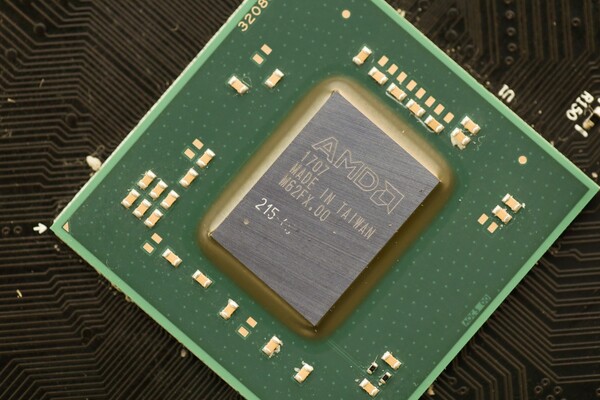
[DigitalToday reporter Jinju Hong] AMD's undisclosed chip “Gainsborough” is being mentioned as a candidate to be used in Valve’s next handheld game device, the Steam Deck 2. A new codename was spotted in AMD drivers, and its semi-custom design and factors such as power and package size appear to overlap in part with the Steam Deck line. Still, it is difficult to conclude from information confirmed so far that Valve is the actual customer.
The Verge reported on Oct. 1 that a previously unknown codename, “AMD Gainsborough,” was recently found in AMD drivers.
The biggest reason Gainsborough has drawn attention is its codename and design approach. The AMD chip used in the first-generation Steam Deck is known by the codename “Aerith,” and Gainsborough is also said to be named after a town associated with a “Final Fantasy VII” character. Speculation also grew because Gainsborough appears to be a semi-custom chip using TSMC’s N3P process.
Semi-custom chips are often designed to meet the needs of a specific customer or product. If Gainsborough was in fact developed for a handheld game device, it could be linked to Valve’s next device, some have suggested.
Logistics records also showed signs that AMD shipped test equipment to validate the Gainsborough chip. That suggests evaluations may be under way for application in a specific customer’s product. Still, the records alone are not sufficient grounds to say the customer is Valve.
The chip’s package size has also drawn interest. Import and export records show Gainsborough is believed to use an FF6 package measuring 25 mm by 25 mm. AMD’s next-generation handheld chips Ryzen Z3 and Z3 Extreme, which were recently leaked, were also presented at 25 mm by 25 mm.
Some materials have put the Ryzen Z3’s target power at around 15 watts. That overlaps with the power range used by the Steam Deck and Steam Deck OLED. Given the importance of power efficiency for handheld game devices, such conditions are being cited as clues supporting the Steam Deck 2 possibility.
But there are also indications against concluding that Gainsborough is a Steam Deck 2-exclusive chip. Even when a semi-custom chip is developed with a specific product in mind, there are cases where it ultimately is not used in that device.
There have also been persistent claims that the Steam Deck’s existing semi-custom chip was not originally designed for Valve’s game device. That suggests a chip AMD developed with another device in mind may later have been used in the Steam Deck.
The codename is also not decisive evidence. The name “Gainsborough” is said to have been set by AMD, not assigned directly by Valve. Valve officials have previously said during a company visit that codenames based on Final Fantasy characters were not specifically something Valve wanted.
There is also a similar case. Microsoft and Asus’ Xbox Ally base model uses the Ryzen Z2 A, and that chip is known as being in the “Aerith Plus” category. That shows that codenames known to be linked with the Steam Deck can also be used in other handheld devices.
The package size is not a decisive clue either. Gainsborough’s 25 mm by 25 mm package is relatively small, but is rather large by Steam Deck standards. Aerith, used in the existing Steam Deck, is known to be about 19 mm by 19 mm even before excluding unused components. Gainsborough may offer higher efficiency, but size alone makes it difficult to judge it as a Steam Deck 2-exclusive chip.
Above all, it has not been confirmed whether the conditions Valve requires for the Steam Deck 2 are clearly being met. Valve has said that to release a next-generation Steam Deck it needs not just a simple performance increase but a “generational leap” in performance and power efficiency.
Valve has maintained that it is still reviewing the timing and approach for releasing the Steam Deck 2. Considering that hardware industry schedules have been affected by issues such as memory supply problems, it is also difficult to say the Steam Deck 2 launch is imminent based solely on confirmation of a new chip.
AMD’s Gainsborough is clearly an interesting clue that raises the possibility of the Steam Deck 2, but it remains only a candidate for now. While the codename, semi-custom design, package size and power conditions partly align with the Steam Deck, it has not been confirmed whether the customer is Valve and whether the chip meets the generational leap in performance and power efficiency Valve demands.
If AMD later discloses Gainsborough’s actual use and specifications, or if additional signs of Valve’s next device development are spotted, the possibility of its use in the Steam Deck 2 is expected to be confirmed more specifically.
 Jinju Hong
hongjj@d-today.co.kr
Jinju Hong
hongjj@d-today.co.kr