
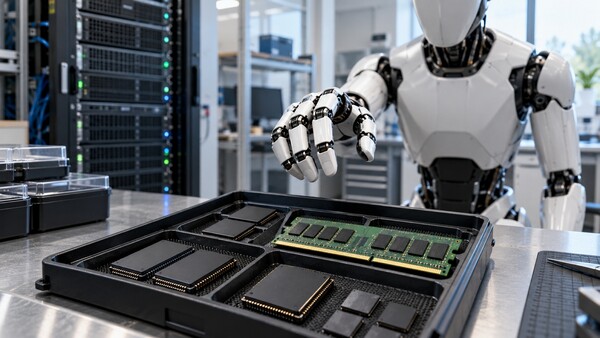
A global memory supply shortage could worsen beyond next year and last through 2028, a forecast said. After AI data centres, robots and other “physical AI” are emerging as new sources of memory demand, making it difficult for supply expansion to catch up, the analysis said.
Tech outlet TechRadar reported on Oct. 1 that Micron forecast in its fiscal 2026 fourth-quarter earnings release that memory and storage supply-demand conditions in 2027 and 2028 would be much tighter than in 2026.
Micron said that even if the industry adds cleanrooms for DRAM production, demand from customers continues to rise, making it hard to predict when supply and demand will return to balance. New production facilities also require significant time for construction, equipment installation and ramp-up to mass production. The company expects demand to exceed supply in both the DRAM and NAND markets in 2027 and 2028.
Robots, as well as AI data centres, are another new variable. Micron said Level 4 and higher self-driving vehicles typically require more than 200 GB of memory and several terabytes of storage, and it expects humanoid robots to be equipped with a similar level of memory and storage devices in the future. Multiple physical AI customers are already testing Micron’s next-generation products.
Micron said physical AI such as robots and self-driving would be a key driver lifting memory and storage demand over the next 10 years. In August it also designated physical AI, including robots, as a next-generation investment area.
With demand for high-bandwidth memory, or HBM, for AI servers also rising rapidly, consumer RAM and storage prices are also unlikely to stabilise sharply in the short term. Micron expects growth in HBM shipments to outpace conventional DRAM through 2028.
 Choi Jae-won
ittt_0801@d-today.co.kr
Choi Jae-won
ittt_0801@d-today.co.kr