
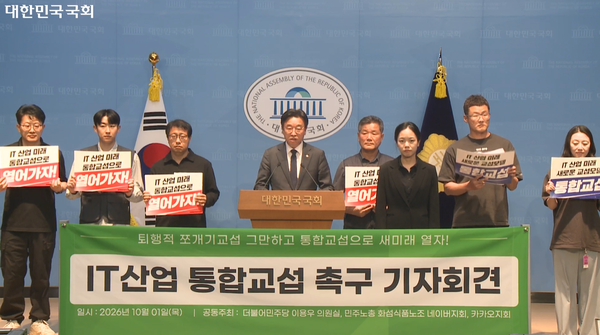
Labor unions at Naver and Kakao are calling for integrated bargaining that spans affiliates. They argue the structure should be changed because parent companies exert influence over affiliates' management and working conditions but do not take responsibility for bargaining, citing separate corporate entities.
The Naver and Kakao branches of the Korean Chemical Textile Food Workers' Union held a news conference at the National Assembly's communications center on Oct. 1 with the office of Democratic Party lawmaker Lee Yong-woo (이용우). They urged the National Assembly and the government to improve the system under the banner of a call for integrated bargaining in the IT industry.
The two unions said they have operated since their establishment in 2018 in a form that encompasses multiple affiliates, and have responded jointly to group-level business restructuring such as spinoffs and sales. After a revised Trade Union and Labour Relations Adjustment Act took effect this year, they each demanded integrated bargaining from Naver and Kakao that includes affiliates, but the unions said the companies refused on the grounds that they have no authority over affiliates' working conditions.
Revisions to Articles 2 and 3 of the Trade Union Act, known as the so-called Yellow Envelope Act, took effect on March 10. At the time, the Ministry of Employment and Labor said the purpose of the revision was to institutionalise bargaining with prime contractors that can substantially and concretely control and determine working conditions, even if they are not parties to an employment contract.
The unions said corporate entities are split by affiliate, but in the IT and platform industry, where parent companies influence major decisions such as investment, business direction, organisational reshuffles and compensation, bargaining at the level of individual entities has limits.
Oh Se-yoon (오세윤), head of the Naver branch, said the union demanded integrated bargaining based on data showing Naver has a substantive influence over affiliates' ownership structures, businesses and sales, personnel matters and working conditions, but the company did not accept it.
The Naver branch said it held a launch ceremony for its demand for integrated bargaining on Aug. 20 and asked Naver to post a notice of the bargaining demand, but the notice has not been posted so far. It plans to file an application on Oct. 2 with the Gyeonggi Labor Relations Commission seeking corrective action on the notice of the integrated bargaining demand.
Oh said, "There are even affiliates for which Naver owns 100 percent of the shares and which are tied to Naver's business and depend on Naver for all their sales." He added, "If Naver is not the employer even for such companies, where is the prime contractor that can be an employer under the Yellow Envelope Act?"
The Kakao branch also said a corresponding bargaining structure is needed because group-level decision-making affects affiliates' workers' employment and working conditions.
Seo Seung-wook (서승욱), head of the Kakao branch, said, "The purpose of the revised Trade Union Act is that if someone has the authority to actually decide working conditions, they must also bear responsibility commensurate with that authority." He added, "A person with authority must not hide behind responsibility."
The Kakao branch also stressed it is not seeking to make working conditions identical across all affiliates through integrated bargaining. It said the aim is to discuss employment measures when businesses are sold or shut down, assess the impact on workers ahead of organisational reshuffles, and jointly discuss group-level measures such as transfers and retraining when businesses fail.
The Korean Chemical Textile Food Workers' Union plans to use the news conference as a starting point to demand that the National Assembly and the government clarify standards for determining an employer under the revised act and the scope of bargaining. It urged the Ministry of Employment and Labor to establish relevant standards and administrative guidelines so labor relations commissions can make judgments consistent with the law's purpose.
The Korean Chemical Textile Food Workers' Union includes labor unions at IT, gaming and platform companies including Naver, Kakao, Nexon and NC.
 Lee Ho-jung
lhj@d-today.co.kr
Lee Ho-jung
lhj@d-today.co.kr