
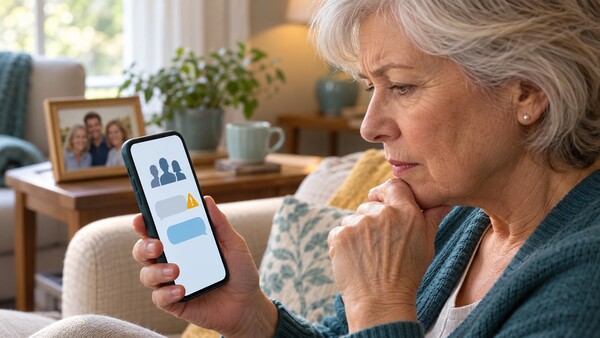
Online scams targeting older people are rising rapidly in the United States, prompting warnings about family impersonation and account takeovers using exposed personal data.
An Incogni analysis introduced by the IT outlet 9to5Mac on Sept. 30 local time showed that about 72 percent of 2024 internet crimes reported to the FBI involving people aged 60 and older were classified as types in which personal information disclosed online could enable crimes or increase harm. Losses from those crimes were estimated at about $4.2 billion, or about 5.704 trillion won. The analysis was not an official FBI causal assessment. Incogni classified the crime types on its own. The FBI’s tally for total losses among people aged 60 and older in 2024 was $4.885 billion, or about 6.6343 trillion won.
Attackers gather disclosed information such as names, phone numbers and family relationships to impersonate family members or acquaintances. A common account takeover method is a SIM swap. By approaching a mobile carrier as if they were the victim and moving the phone number to another SIM, they can intercept text messages and SMS-based two-factor authentication codes. If they then break into a messaging account or a family group chat, they can obtain additional personal data, such as travel plans or hospital visits, and make the impersonation more sophisticated.
AI voice cloning has also emerged as a risk factor. The FBI said, "There are cases where criminals imitate family members or acquaintances with AI-generated voices." It also said, "If you are urgently asked to wire money or provide personal information, confirm the person through a separate channel such as a phone number you already know." It also suggested agreeing in advance on a secret word or phrase among family members.
For account security, using an authentication app or phishing-resistant authentication methods is relatively safer than SMS. The Cybersecurity and Infrastructure Security Agency (CISA) also said SMS authentication is vulnerable to SIM swaps or telecommunications network attacks, and recommended other forms of multi-factor authentication such as authentication apps.
Reducing exposed personal information and strengthening account authentication, while making it a habit to double-check through another means of communication even in an emergency contact from family, is cited as key to preventing 피해.
 Jae-won Choi
ittt_0801@d-today.co.kr
Jae-won Choi
ittt_0801@d-today.co.kr