
[DigitalToday reporter Hojeong Lee] Toss is shifting the center of its miniapp ecosystem, which users can access without installing a separate app, from expanding listings to competing for visibility. After focusing on expanding miniapps, it plans to change its operating system to give more exposure opportunities to miniapps with better user experience and actual usage performance.
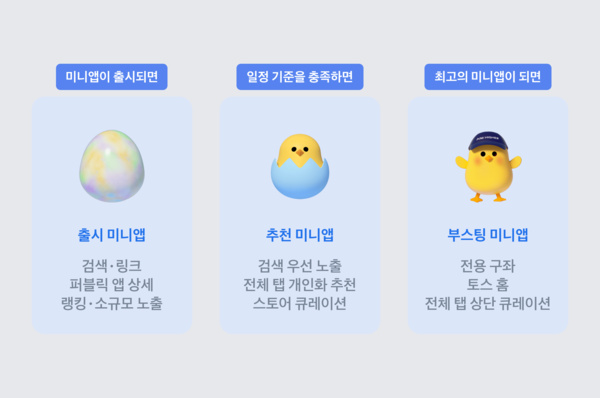
According to Toss on Wednesday, App in Toss will revamp its miniapp exposure policy into three tiers from Oct. 22: launch miniapps, recommended miniapps and boosting miniapps. The same standards will apply not only to new miniapps but also to those already in service.
◆Listing does not mean being seen
Miniapps that pass internal review become launch miniapps. Users can access them through search in the Toss app or via shared links, but they are not automatically shown in major recommendation areas.
To move up a tier, a miniapp must meet additional conditions. Criteria include user experience (UX), actual usage metrics, user reviews and service performance. Miniapps that meet the conditions are classified as recommended miniapps. They are featured more often in the miniapp store and the Toss All tab and are prioritised in search results.
Competition also takes place among recommended miniapps. Toss editors evaluate actual usage and select boosting miniapps from services that rank at the top for repeat visits within a category and conversion rates for purchases and reservations. Boosting miniapps are shown in a separate recommendation space at the top of the Toss home and the All tab.
Even among miniapps listed on the same App in Toss, opportunities for exposure to users can differ significantly.
The exposure gap is also substantial. During the beta period, boosting miniapps were exposed about 20 times more than recommended miniapps, Toss said. The structure means entering the recommended tier and then being selected for boosting has a more direct impact on acquiring users than launching a miniapp on Toss itself.
The background to Toss subdividing exposure criteria is the expansion of its miniapp ecosystem. App in Toss miniapps started at about 100 in July last year and exceeded 10,000 in August.
App in Toss is an open platform where developers can launch services after building miniapps and passing review, without separate partnerships or contracts. Partners can provide services within the Toss app without requiring users to install a new app and create touchpoints with about 30 million users.
While it initially applied some standards flexibly to help partners launch services quickly, it has recently moved to a stage of managing the quality of the growing number of miniapps and deciding which services to show more often.
◆Quality control after expansion; alert and ad system also to be revised
Toss is also tightening operating standards along with the revamp of the miniapp exposure system.
From Wednesday, it will sequentially inspect all non-game miniapps in operation for about a month to check whether they comply with launch guidelines.
Toss said it had temporarily applied some standards flexibly to support partners' quick launches early on. As the number of miniapps in operation and users increased, it said, there is a need to apply the same quality standards to all services.
Miniapps found to need fixes must request a re-review and obtain approval within 14 days of being notified of the results. If approval is not obtained within the period, they will be hidden. Exposure will automatically resume once approval is received later.
How miniapp operators acquire users will also change.
App in Toss will end the operation of promotional push notifications and alerts through Smart Sending from Oct. 1. Toss said it had run promotional alerts without increasing the total volume of alerts users receive, but as more materials were registered, materials that could not actually be sent also increased. Functional push notifications and alerts needed during service use will continue as before.
Instead, it is expanding ways to attract users within the Toss app. Examples include the 'Browse miniapps and get points' promotion, which gives points to users when they use miniapps, and advertising products within the Toss app.
In particular, the 'Various benefits missions' area in the Toss Benefits tab, where 'Browse miniapps and get points' appears, generates about 600,000 page views a day. Users select miniapps they are interested in and receive points if they use them for a set period.
The changes show that App in Toss is shifting from a distribution channel that simply hosts external services to a platform that directly manages miniapp exposure and growth.
In that sense, it resembles existing app markets such as Apple's App Store or Google Play. In app markets as well, exposure in search and recommendation areas has a major impact on user acquisition more than registering an app itself. App in Toss, however, is structurally different in that users can access services immediately within Toss without installing a separate app.
An industry official said, "Toss miniapps appear to be moving from a stage of expanding listings to a stage of competing on performance," adding, "Going forward, it will be more important than getting into Toss to make users come back and convert to actual actions."
 Hojeong Lee
lhj@d-today.co.kr
Hojeong Lee
lhj@d-today.co.kr