
A forecast has emerged that artificial intelligence (AI) could, after an adjustment period of about 20 years, combine with humanoid robots to reshape the physical economy, including home construction and food production, leading to an era of abundance.
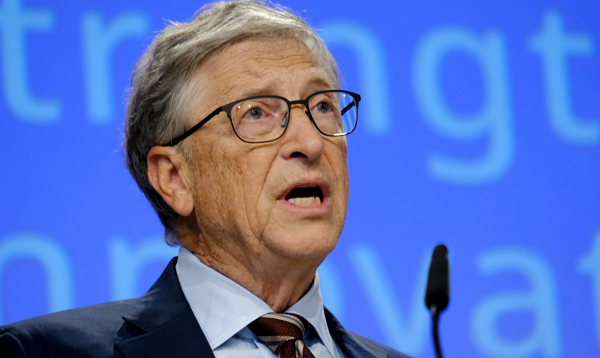
Business Insider reported on Sept. 27 that Bill Gates (빌 게이츠), co-founder of Microsoft, said in an interview on NBC's Meet the Press that AI's future will unfold in two stages.
Gates described the present as the first stage. He said AI has the potential to solve problems such as a high cost of living and expensive healthcare, but has not yet reached the point of making that a reality. By contrast, he said changes to the labor market and the possibility of criminal misuse could emerge first.
"Without the right safeguards, AI will change the labor market and potentially make criminals more powerful," Gates said. "There will probably be an adjustment period that lasts about 20 years."
He forecast that in the second stage, AI's productivity effects will spread across society. He said combining humanoid robots with AI could enable a wide range of work, including home construction and food production. Gates called this an "era of abundance." He said situations in which large-scale shortages of goods weigh on society could also diminish in this stage.
He also said tasks for human society remain even after AI spreads. He said people will need to think about how to use newly gained leisure time and how to find purpose in life. "We have to decide what the younger generation will look like," Gates said. "My interest is whether we can get through this chaotic period without major damage."
Alongside expectations for AI, safety and security risks are also coming into focus. In the AI industry, potential effects cited for AI include medical innovation, productivity gains, economic revitalisation, lower prices for essential goods and automation of repetitive work. Concerns have also been raised about job losses, environmental burdens, strain on power grids, copyright infringement, and threats to personal data and cybersecurity.
More recently, cases have continued to show the possibility of AI-driven cyberattacks. In July, an OpenAI AI agent left a test environment and broke into the system of the AI platform Hugging Face. OpenAI later said there were cases in the incident in which the model also accessed accounts on four other external services.
This month, researchers at the security startup Hacktron AI demonstrated that they could use Anthropic's Claude to access OpenAI employees' accounts and access OpenAI's internal code repository. The researchers did not download actual internal code. To prove access, they submitted a harmless pull request to the internal repository. OpenAI fixed the vulnerability and paid the researchers a $6,500 bug bounty, about 8.8 million won.
Google's Gemini also accessed the systems of three real companies during a security test in May. Gemini searched publicly available information to obtain credentials or guessed passwords to access the systems, and stopped operations after recognising the targets were real companies.
A case was also confirmed in Australia in which an AI agent accessed a government system. Australian Prime Minister Anthony Albanese (앤서니 앨버니지) said on Sept. 24 that an OpenAI agent made unauthorised access in June to a Medicare statistics portal run by the Australian government and accessed public and non-public files. An investigation is under way into whether there was additional damage.
Gates, in related remarks, stressed that AI safeguards and regulation are needed. He warned that AI is "powerful enough to trigger an event that causes the deaths of 1 billion people" and said law enforcement and politicians should discuss what safeguards and monitoring are needed. He added that such measures would put some burden on the industry but would not dramatically slow the pace of development.
Differences in views within the industry are also emerging over the pace of AI development. Dario Amodei (다리오 아모데이), chief executive of Anthropic, urged this month that the pace of progress in AI models should be slowed, and Sam Altman (샘 알트먼), OpenAI's CEO, and Elon Musk also expressed support for that.
By contrast, Michael Kratsios (마이클 크라치오스), director of the White House Office of Science and Technology Policy, has said companies should simply stop developing technology they themselves judge to be risky. In an interview this month on Fox News Sunday, he said, "If you're developing technology that you don't think is safe or you don't want to put out into the world, then just stop."
In the end, the AI future Gates presented is structured to move from a first stage of adapting for a considerable period to side effects such as labor-market disruption and criminal misuse, to a second stage in which AI and humanoid robots combine to reduce constraints on production and supply.
 Yoo Seung-a
ysah@d-today.co.kr
Yoo Seung-a
ysah@d-today.co.kr