
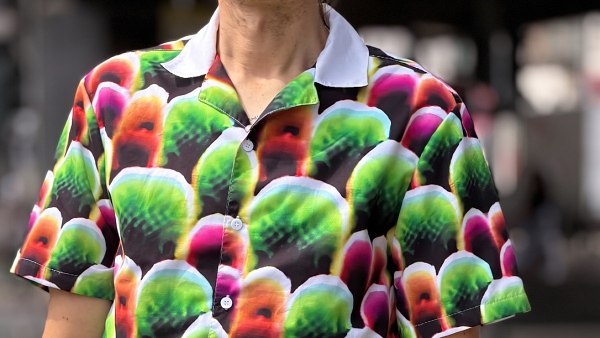
A so-called digital camouflage shirt has been unveiled that prevents AI surveillance cameras from recognising the wearer as a person. On Sept. 27, local time, online media outlet Gigazine reported that Berlin-based artist Simon Weckert (사이먼 웨커트) made the shirt by applying patterns that target the open-source object detection model YOLO.
In a video released by Weckert, the YOLO system that had labelled a person as "PERSON" did not respond to an individual wearing the shirt. It failed to classify the person as a person even with someone standing in front of the camera.
Weckert also pointed to Berlin's public surveillance environment. He explained that in Berlin, government surveillance cameras film public places and AI classifies pedestrians' behaviour as "normal" or "suspicious". It has not been confirmed whether such surveillance cameras actually use YOLO.
Weckert saw that opacity itself as a problem. He drew a line, saying the shirt was neither a tool to evade the eyes of police nor a means to guarantee anonymity. No pattern can penetrate every system in every situation, and he said this camouflage makes no such claim.
Instead, he attached meaning to the act of wearing the shirt in public itself. He explained that it is an expression that not everyone wants to be read by machines. The shirt is not a technology that completely avoids AI surveillance, but rather closer to a work that exposes vulnerabilities in object detection models and the opacity of surveillance systems. He said the core of this attempt is using technology not as a means of evasion but as a medium to raise an issue.
Weckert has continued work that takes issue with a digitally surveilled society. He previously carried out an experiment in which he pulled a handcart loaded with large numbers of smartphones along roads to make it appear on Google Maps as if congestion had occurred. The shirt sells for about 100,000 won. Weckert said he plans to release a new design whenever a new YOLO comes out.
 Hyunwoo Choo
cookinpapa@d-today.co.kr
Hyunwoo Choo
cookinpapa@d-today.co.kr