
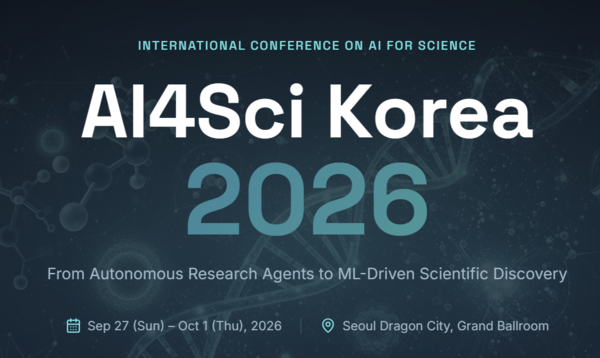
South Korea will host its first international academic conference in the AI for science field, which combines science and technology with AI.
The Ministry of Science and ICT will hold the AI4Sci Korea 2026 international academic conference at the Dragon City Hotel in Yongsan-gu, Seoul, from Sept. 27 to Oct. 1.
The event is jointly hosted by the Korean Society for Applied Artificial Intelligence (AI Friends), the Korea Science AI Forum and the Gwangju Institute of Science and Technology (GIST), with support from the ministry. About 600 researchers and industry experts from 19 countries will take part and introduce about 220 papers.
This year's theme is "Autonomous research agents and AI-based scientific discovery". The programme focuses on autonomous AI agents that plan and carry out research processes on their own, as well as AI convergence research across scientific fields.
Sessions will be held across 15 areas: AI scientists and agents, AI policy, ethics and governance, life sciences, materials and chemistry, semiconductors and displays, nuclear power and nuclear fusion, earth science, mathematics and computational science, mechanical engineering, energy and environment, autonomous laboratories, industrial applications, physics, and brain-computer interfaces.
Keynote speakers include Seok Cha-ok (석차옥), a professor in the Department of Chemistry at Seoul National University; Thomas Zacharia (토마스 자카리아), AMD senior vice president; and Lim Woo-hyung (임우형), co-head of LG AI Research. A total of 23 people, including Juan de Pablo of New York University in the United States, will deliver lectures. Including invited talks, about 80 speakers from 10 countries will introduce their latest research results.
A policy forum will also be held on the government's K-Moonshot and trends in science and technology AI policy in each country. Linked to the seven SEED projects, a national advanced technology strategic initiative, government-funded research institutes and companies will present cases of AI use in areas including small modular reactors (SMRs), nuclear fusion and advanced bio.
The ministry and Google DeepMind will jointly hold a special session as a follow-up to a business agreement signed in April. The National AI Science Research Center (NAIS) will run an AI hackathon that integrates AI agents across the entire research and development process.
The ministry will also 추진 an industry-academia-research convergence research project centred on the National AI Science Research Center to connect conference outcomes to joint research. It will verify feasibility through small-scale exploratory research and link strong projects to follow-up research.
Koo Hyuk-chae (구혁채), first vice minister of the Ministry of Science and ICT, said the government would connect and open science and technology AI resources and use them to accelerate the achievement of the 12 K-Moonshot missions in areas including bio and future energy. He said he hoped the conference would establish itself as a venue for exchange linking the global science and technology community.
 Jin-ho Lee
jhlee26@d-today.co.kr
Jin-ho Lee
jhlee26@d-today.co.kr