
[DigitalToday reporter Oh Sang-yeop (오상엽)] South Korean stocks are expected to seek direction this week as they digest external variables that built up during the Chuseok holiday. Worries over trade frictions eased somewhat after a U.S.-China summit, but U.S. inflation, Micron earnings, oil prices and long-term interest rate moves are expected to determine whether the KOSPI can rise further.
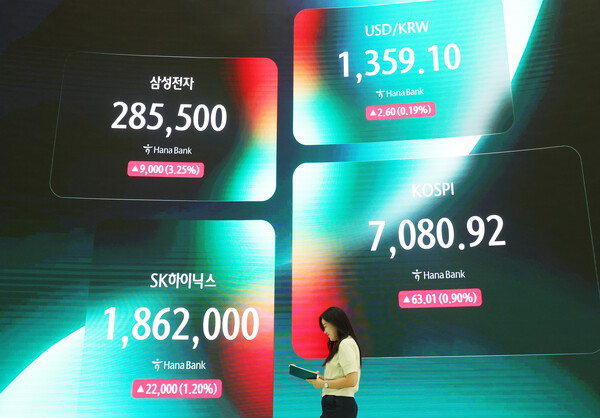
On Sept. 23, the last trading day before the holiday, the KOSPI ended at 7,080.92, up 0.90 percent from the previous session. The index swung during the session but entered the holiday holding above 7,000.
U.S. stocks rose over the holiday. On Sept. 25, the Standard & Poor's 500 ended up 0.51 percent at 7,743.41, the Nasdaq gained 0.48 percent to close at 27,068.72 and the Dow Jones Industrial Average rose 0.93 percent to 51,828.62.
The first variable this week is the outcome of a U.S.-China summit held during the holiday. U.S. President Donald Trump and Chinese President Xi Jinping held talks on Sept. 24 and reaffirmed the need to stabilise relations and cooperate.
The existing trade truce was extended through Jan. 10, 2027, but there was limited progress on core issues such as tariffs, advanced technology and Taiwan. The two countries agreed to continue dialogue in the AI field.
Markets view the meeting as closer to postponing uncertainty than resolving U.S.-China frictions. The extension makes it less likely that tariff clashes will intensify again immediately, but issues that would directly affect South Korea's semiconductor sector, such as U.S. controls on advanced-technology exports and China's rare-earth policy, will need to be checked through further negotiations.
Oil price moves have turned positive for South Korean stocks. On Sept. 25, WTI ended at $92.41 a barrel, down 2.3 percent from the previous session. Reports that the United States and Iran are exploring the possibility of phased negotiations to end the war pushed oil prices down. Military tensions in the Middle East remain, making it hard to rule out another sharp rise in oil prices.
With the KOSPI having recently reacted sensitively to oil, it is important whether oil stabilisation continues. Falling oil prices could ease inflation burdens and pressure for long-term interest rates to rise. If prices climb back to around $100 a barrel, inflation and rates could weigh on stocks at the same time.
The U.S. August personal consumption expenditures (PCE) price index is due on Sept. 30. The U.S. Bureau of Economic Analysis (BEA) is also set to release personal income and consumption spending data that day. Industry expects headline PCE to be around 3.7 percent year on year and core PCE to be around 3.4 percent.
If inflation stays within expectations or slows, worries about additional rate hikes by the Federal Reserve could ease, supporting stability in Treasury yields and the dollar. If inflation comes in above expectations, the chance of another rate hike in October could rise again, weighing on domestic growth stocks and semiconductors.
Micron earnings due the same day are also a factor that will shape investment sentiment toward semiconductors. Micron is set to release results for fiscal 2026 fourth quarter on Sept. 30 local time.
Markets are expected to focus more on next-quarter guidance and the outlook for memory supply and demand than on revenue and profit. If it is confirmed that memory prices are rising and demand from AI data centres continues, earnings expectations may hold for South Korean semiconductor shares including Samsung Electronics and SK Hynix.
If signals emerge of higher supply or a slowdown in price gains, profit-taking pressure could increase in semiconductor shares that have recently rebounded.
The U.S. September jobs report is also due on Oct. 2. With the Fed checking the economy and labour trends as well as inflation, stronger-than-expected jobs data following PCE could heighten worries about further tightening. The U.S. Bureau of Labor Statistics (BLS) is set to release the September jobs report at 8:30 a.m. local time on Oct. 2.
Valuation 부담 on the South Korean stock market itself has eased. Industry estimates the KOSPI's 12-month forward price-to-earnings ratio is staying in the mid-5 range, while forward earnings per share is seen above 1,200 points. With corporate earnings outlook holding while stock prices have risen relatively less, there is room for valuation normalisation to continue if external variables stabilise.
The 7,100 to 7,200 range is cited as short-term resistance for the KOSPI. The index has recently regained 7,000, but foreign buying and a continued rise in semiconductors would need to support a break above the area where the 120-day moving average and the previous peak are located.
By sector, semiconductors and IT hardware are still likely to remain at the centre. Rotations could also broaden to retail and distribution, shipbuilding, chemicals, defence, secondary batteries and power equipment, where earnings 전망 has been relatively resilient compared with recent share price declines.
Ultimately, the key question this week is whether reduced external uncertainty after the U.S.-China summit translates into actual stability in oil prices and interest rates. If PCE stays within market expectations and Micron confirms solid memory demand, the KOSPI could try again to break above 7,100 to 7,200.
If oil and long-term yields rise again or semiconductor earnings expectations weaken, the market could remain range-bound around 7,000.
Lee Kyung-min (이경민), a researcher at Daishin Securities, said the KOSPI is still in an extremely undervalued valuation zone. He said the U.S.-China summit during the Chuseok holiday, subsequent PCE inflation and Micron earnings could be the first attempt at valuation normalisation to confirm whether expectations or worries are reality.
 Oh Sang-yeop
yub@d-today.co.kr
Oh Sang-yeop
yub@d-today.co.kr