
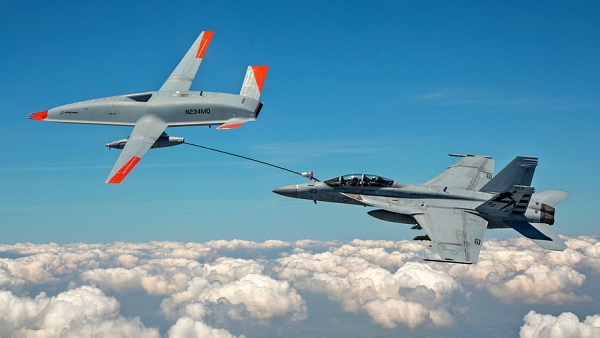
The U.S. Air Force is reviewing options to make its next-generation aerial refuelling aircraft uncrewed. The move comes as development of the Navy’s uncrewed tanker picks up pace.
Foreign media including U.S. defence outlet Defense One reported that Daniel Tulley (대니얼 털리), commander of the U.S. Air Force’s Air Mobility Command, said at the Air, Space & Cyber 2026 conference: "I do not think the future means of aerial refuelling necessarily has to be crewed."
Tulley said the next-generation tanker must be networked and have self-defence capabilities. He said the Air Force needs to examine whether it must be crewed, could be optionally crewed or autonomous, or whether a combination of solutions is the answer.
The Air Force is currently bringing in Boeing’s KC-46 Pegasus. It spent $12 million this year to review purchasing new tankers, but cut the related budget to zero in its fiscal 2027 budget request. Instead, it asked for $13 million under the heading of an "advanced refuelling system".
Behind the shift is the Navy’s Boeing MQ-25 Stingray. The MQ-25, which made its first flight earlier this year, recently received approval for low-rate initial production. The Navy ordered three more, bringing its total to 14.
The scale the Air Force needs is different. The KC-46 can carry about 96 tonnes of fuel and fly 11,900 km, but the MQ-25 has a range of about 800 km and a maximum fuel load of about 7.5 tonnes. Tulley said an uncrewed tanker with the operational radius the Air Force needs would have to be a very large aircraft, adding it has not yet reached the stage of operating large aircraft fully autonomously.
The industry sees the technology gap narrowing. Matthew George (매튜 조지), CEO of autonomous flight systems firm Merlin Labs, said the company plans to apply autonomous flight to the C-130J, which is in the same class as the KC-135 Stratotanker. He said the Air Force can move toward uncrewed refuellers step by step by introducing autonomous functions in a supporting role while a crew remains on board.
George cited emergency decision-making, such as choosing a diversion route in bad weather, as the toughest task. Certification is also key. He said there is no point without certification and safety, adding the company is working closely with the Air Force on certification this year. Merlin Labs’ technology has completed a critical design review. If it goes as planned, it would be the first case in which an autonomous flight system fully controls a U.S. Air Force aircraft in operational service. The flight timing was not disclosed.
 Hyunwoo Chu
cookinpapa@d-today.co.kr
Hyunwoo Chu
cookinpapa@d-today.co.kr