
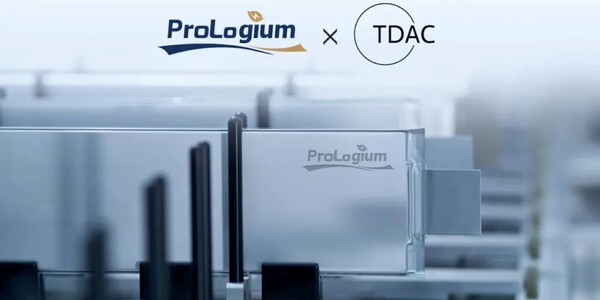
Mercedes-Benz has secured priority access to Taiwanese battery maker ProLogium’s latest fourth-generation all-solid-state battery cells and will begin verifying next-generation electric-vehicle (EV) battery technology. The two companies will assess whether the fourth-generation battery can be applied to vehicles, based on cooperation that has continued for about 10 years.
On Sept. 24 (local time), EV-focused outlet Electrek and ProLogium said Mercedes-Benz and ProLogium signed a joint test agreement. Under the agreement, Mercedes-Benz secured the right to test ProLogium’s fourth-generation “superfluidized inorganic lithium ceramic battery” cells with priority access.
Mercedes-Benz plans comprehensive tests of the battery cells’ electrical performance, thermal characteristics and safety at dedicated facilities and external specialist testing institutions. The test results will be used to assess whether the technology can be applied to future vehicles.
ProLogium explained that the fourth-generation battery platform was designed with mass production and cost competitiveness in mind, which it said are challenges in commercialising all-solid-state batteries. It said the platform applies a non-flammable inorganic electrolyte, a ceramic separator and its own active safety mechanism to improve safety, while supporting fast charging, high output and performance in low-temperature environments.
Mercedes-Benz and ProLogium have worked together since 2016. The companies have verified multiple lithium ceramic battery technologies, including pouch cells, next-generation prismatic cells and bipolar technology. ProLogium said it expanded cooperation from the early battery development stage to reviewing whether the latest fourth-generation technology can be applied to vehicles.
ProLogium is also pushing to expand battery production facilities. It opened its first GWh-scale gigafactory in Taiwan in May 2024, and in February 2026 held a groundbreaking ceremony for phase one construction of a second battery gigafactory in Dunkirk, France. The Dunkirk plant is designed to secure annual production capacity of 4 GWh in phase one, with that capacity to be achieved in stages by 2030. Total designed production capacity is up to 44 GWh.
ProLogium said its fourth-generation all-solid-state battery cells provide up to 400 Wh/kg energy density and can charge from 5 percent to 80 percent in 6.4 minutes. A report by third-party testing institution TUV showed ProLogium’s 185.4 Ah large-format 3.5-generation cell recorded an energy density of 381 Wh/kg by mass. ProLogium said it has been mass-producing that 3.5-generation battery at its Taiwan production facility since September 2026.
ProLogium said in May it signed a business combination agreement with special purpose acquisition company Translational Development Acquisition and would pursue a Nasdaq listing. If the transaction is completed and the company meets relevant approvals and listing requirements, it plans to list on Nasdaq in the fourth quarter of 2026 under the ticker symbol “PRLG.”
Mercedes-Benz is also working with U.S. all-solid-state battery company Factorial Energy in addition to ProLogium. Mercedes-Benz announced last year that a modified EQS fitted with 106 of Factorial’s all-solid-state battery cells drove more than 1,200 km on a single charge. Mercedes-Benz has set a goal of launching its first mass-produced EV equipped with all-solid-state batteries by 2030.
The agreement with ProLogium can be seen as part of Mercedes-Benz’s process of expanding the scope of verification needed to apply all-solid-state battery technology to actual vehicles. The agreement itself does not confirm the launch of a mass-produced car equipped with ProLogium’s fourth-generation battery, and Mercedes-Benz plans to assess potential vehicle application based on test results.
 Seung-a Yoo
ysah@d-today.co.kr
Seung-a Yoo
ysah@d-today.co.kr