
[Digital Today reporter Oh Sang-yup] The People Power Party decided to re-examine the current tax system, including the timing of the introduction of digital asset taxation scheduled for January 2027. It said it is difficult to identify acquisition costs for transactions through overseas exchanges and personal wallets, and that tax fairness among assets has been raised after the abolition of the financial investment income tax.
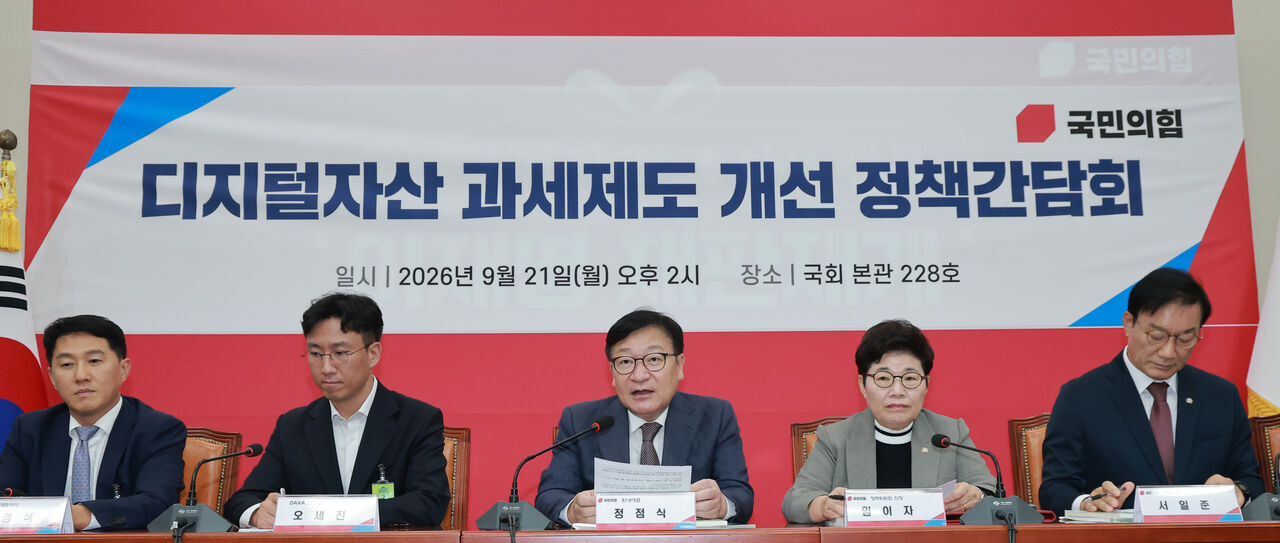
People Power Party floor leader Chung Jum-sik (정점식) said at a policy meeting on improving the digital asset taxation system held at the National Assembly in Seoul's Yeouido on Sept. 21 that he would closely review what needs to be re-examined, including the timing of taxation, and what should be supplemented for reasonable taxation.
Attendees included Chung and People Power Party policy chief Lim I-ja (임이자), other party leaders, the Digital Asset Exchange Alliance, and officials from the five major won-based exchanges: Upbit, Bithumb, Coinone, Korbit and GOPAX.
The People Power Party first pointed to limits in the current tax framework in accurately identifying investors' actual acquisition costs and profits and losses. It said that, given the nature of digital assets in which trading takes place not only on domestic exchanges but also across overseas exchanges and personal wallets, it is difficult to verify all past acquisition costs and transaction records.
It also said tax standards need to be refined for transaction types that differ from simple trading, such as staking and decentralised finance (DeFi). As transaction methods diversify, it said detailed standards need to be sufficiently prepared on which income is subject to taxation and how losses and costs will be reflected.
Chung said the party needs to examine whether it is appropriate to push ahead with the tax schedule as planned when the industry's institutional foundation is not sufficiently in place. He said the government's job is not simply to collect taxes on a set date, but to prepare predictable and fair standards so they can be properly implemented in the field.
After the abolition of the financial investment income tax, the issue of tax fairness between stocks and digital assets also emerged as a key point.
Under current law, income generated by transferring or lending digital assets is classified as other income. A basic deduction of 2.5 million won is applied to annual income, and a 20 percent tax rate is applied to the excess; including local income tax, the rate is 22 percent.
By contrast, in principle no capital gains tax is imposed on gains from listed shares traded on-exchange by ordinary individual investors.
Lim said the situation has changed significantly compared with when the digital asset taxation system was first designed. She said the financial investment income tax 추진 at the time was abolished, and no tax is imposed on capital gains for small investors trading listed shares on-exchange.
She said that while taxation is scheduled for digital asset investment income, the party needs to fully examine concerns raised about tax fairness among assets. She also stressed the need to clarify what will be taxed, when, and under what standards for new transaction methods such as staking and DeFi.
The People Power Party also said the Digital Asset Basic Act under discussion in parliament and the tax system should be overhauled together. It said that if taxation is implemented first before the basic institutional framework is finalised, including the legal nature of digital assets and regulation of operators, it could cause confusion in the market and among investors.
Lim said work to establish the legal nature and institutional framework for digital assets should be linked to the tax system. She said that if taxation is implemented first simply because a date has been set when systems are not sufficiently prepared, confusion and the burden will fall on investors and the field.
The industry also conveyed the need to review systems and infrastructure ahead of implementing taxation.
Oh Se-jin (오세진), chairman of DAXA, said controversy continues over income classification, tax infrastructure and the timing of implementation even up to now, ahead of taxation next year. He said that reflects a consensus that the system must be handled carefully.
He added that while the user protection law has taken effect in the digital asset market, the regulatory framework remains incomplete. He said the industry will also actively move to revitalise the market by sufficiently discussing and consulting on the Digital Asset Basic Act.
 Oh Sang-yup
yub@d-today.co.kr
Oh Sang-yup
yub@d-today.co.kr