
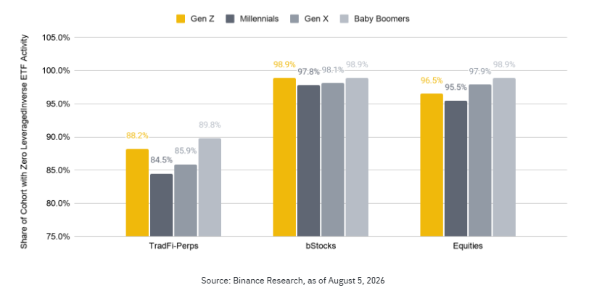
Gen Z investors were found to trade less frequently than millennials and Gen X when investing in equity-type products on crypto exchanges, while leaving more money in ETF and single-stock purchases than in leverage.
CryptoSlate reported on Aug. 19, citing a report Binance Research released on Aug. 12, that Gen Z recorded the lowest turnover among working-age groups across three products: spot stocks, tokenised stocks bStocks and traditional finance perpetual futures (TradFi Perpetuals). It added the analysis period was short and Binance’s spot stock product only began to build scale in June 2026.
The clearest difference appeared in ETFs. In early August, ETFs accounted for 25% of Gen Z’s spot stock trading volume, up sharply from 14.6% in June. Over the same period, millennials’ ETF trading share was 9.5%. That meant Gen Z allocated more than twice the share of its stock trading to ETFs than millennials.
A similar pattern appeared in actual fund flows. Unleveraged ETFs accounted for 21.9% of Gen Z’s net equity inflows in July, up from 18.5% in June, while the share for individual stocks fell to 74.2% from 77%. As total net investment fell 17.4% in July, unleveraged ETF inflows slipped 2%. Inflows into individual stocks fell 20.4% and leveraged products dropped 28.5%.
Its holding behaviour was also closer to long-term investing. Some 22% of Gen Z spot stock accounts had never placed a sell order. The share was 19% for Gen X and 9% for baby boomers. Millennials were higher at 30%.
Among Gen Z accounts that only bought and did not sell, the spot stock product with the largest average buy amount was the Schwab U.S. Dividend Equity ETF (SCHD) at $16,567 per trade. Broadcom followed at $12,370. In bStocks, the average buy amounts for Tesla and Nvidia were $633 and $514, respectively.
Leveraged products were used relatively for short-term trading. Gen Z’s TradFi Perpetuals accounts made an average of 13 trades a month, fewer than millennials at 17, Gen X at 16.5 and baby boomers at 19. The share of high-frequency trading accounts was also lower at 14%, compared with 18% for millennials and Gen X and 16% for baby boomers.
The difference was clearer in where money actually stayed. In July, leveraged and inverse ETFs accounted for 9.25% of Gen Z’s spot stock trading value, but just 3.93% of net inflows, falling to 2.65% in early August. In TradFi Perpetuals, about 60% of Gen Z accounts were net buyers, but net fund flows were less than 1% of total trading volume. By contrast, the net inflow ratio for spot stocks was 26.5%, and the average net inflow per account was $1,898.
Gen Z accounts for about 44% of users of Binance’s spot stocks and bStocks, and 45% of TradFi Perpetuals users. More than 90% of traditional finance product users are based in emerging markets, and 13% of Binance spot stock users were Gen Z in emerging markets with stock assets of less than $2,000. The ability to access U.S. stocks and ETFs in a familiar trading environment was cited as a background to this usage pattern.
The analysis concludes that using crypto exchanges does not necessarily mean Gen Z prefers high-risk investment. Binance data instead showed Gen Z leaving more funds in ETFs and stocks than in leveraged products and continuing to buy rather than sell.
 Seung-a Yoo
ysah@d-today.co.kr
Seung-a Yoo
ysah@d-today.co.kr