
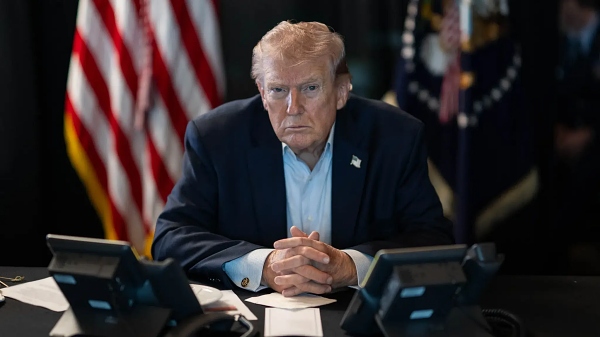
U.S. President Donald Trump said he would create a dedicated "AI task force" to oversee artificial intelligence policy and appoint an AI chief.
On Sept. 20 (local time), Cointelegraph, Newsweek and other foreign media reported that Trump said on Sept. 19 on his social media platform Truth Social that he would manage the fast-growing AI sector while not introducing additional regulations that could hinder innovation.
Trump said, "I am creating an AI task force like the Space Force, which was a big success during my first term," and added that he would announce an AI chief in the near future. He also added, "Only people with high IQ should apply."
It is not known whether the AI task force would be part of the military chain of command or a civilian body or separate department. Trump did not disclose its specific role or launch timeline, and the White House was also reported not to have responded to related inquiries.
The announcement comes as concerns persist that AI is spreading too quickly. Discussions among major AI companies and industry figures have recently become more active over how to balance development speed with safety. Dario Amodei (다리오 아모데이), chief executive of Anthropic, on Sept. 12 put forward a three-step proposal to rein in the pace of AI development. He warned that if development continues without safeguards, "it could outpace our ability to understand and control this system."
Industry reaction is mixed. Sam Altman (샘 알트먼), chief executive of OpenAI, and Elon Musk responded positively to Amodei's proposal, while Jensen Huang (젠슨 황), chief executive of Nvidia, argued such regulation is not necessary. The difference in views over AI safeguards and growth speed has resurfaced.
The plan is marked by an emphasis on creating a management system rather than tightening regulation. Since Trump has sent a message that he will not add regulations that could slow innovation, the possibility has been raised that U.S. AI policy could be reshaped around a dedicated organisation and a policy chief rather than strong preemptive regulation.
For now, the confirmed details remain at the level of Trump's concept. With the organisation's legal status and authority, its relationship with existing government departments, and the scope of oversight of private companies not disclosed, whether it will lead to actual policy is expected to be determined by follow-up announcements.
 Yoonseo Lee
yslee@d-today.co.kr
Yoonseo Lee
yslee@d-today.co.kr