
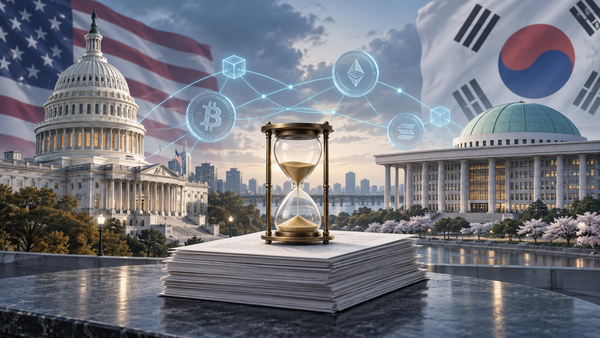
The CLARITY Act, which regulates the structure of the U.S. digital asset market, hit a roadblock in a procedural vote in the Senate, and analysts say it could become a variable in South Korea’s discussions on its digital asset framework bill.
The financial investment industry said on Sept. 21 that the U.S. Senate on Sept. 15 local time held a procedural vote to begin full Senate consideration of the CLARITY Act, but it failed 49-50 and did not secure the 60 votes required to pass. The bill itself has not been scrapped, but additional negotiations and more support are now needed to relaunch it.
The CLARITY Act is a bill that separates supervisory authority between the Securities and Exchange Commission (SEC) and the Commodity Futures Trading Commission (CFTC) according to the legal nature of digital assets and sets a registration and oversight framework for trading platforms.
The key is to clarify in law which assets are considered securities or commodities and what regulations apply to businesses that handle them.
Issues in the vote included safeguards against conflicts of interest involving U.S. President Donald Trump and his family’s digital asset businesses, and concerns that stablecoin rewards could lead to bank deposit outflows. With limited time for negotiations ahead of the November midterm elections, it has become unclear whether it will be handled within the year.
The industry expected that, given the time needed for further negotiations, the timing could be pushed back to the first half of 2027.
Follow-up steps continued even after the procedural vote failed. The SEC on Sept. 17 local time granted temporary and conditional regulatory exemptions to platforms that trade tokenised U.S.-listed stocks.
It allows blockchain-based stock trading on condition that the number and size of traded products are limited and that the same rights as existing stocks are guaranteed.
While Congress debates an oversight framework for the overall market, regulators appear to be preparing pathways for individual businesses to enter the regulated system using existing authority. Still, some point out that rules and interpretations by administrative agencies alone make it difficult to resolve the entire legislative vacuum.
Park Seong-je (박성제), a senior researcher at Shinhan Investment Corp, analysed that unlike congressional legislation, rules and interpretations by administrative agencies can be revised depending on future changes in government or court rulings, leaving long-term regulatory uncertainty.
He said businesses that require legal standards, such as determining whether tokens are securities, the exchange registration system and rules for decentralised finance (DeFi), are likely to be relatively affected.
In South Korea, attention is focused on the indirect impact U.S. legislative delays may have on discussions over the digital asset framework bill. That is because multiple issues, including issuers of won stablecoins, how banks would participate, and rules for exchanges and custody businesses, are being discussed together around the framework bill.
Analysts say that if South Korea seeks to finalise its system after confirming the United States’ final market structure, it could take longer to coordinate contentious issues.
Kim Se-hee (김세희), a researcher at Eugene Investment & Securities, said there had been expectations that if the CLARITY Act passed, global regulatory standards would be specified and South Korea’s second-stage legislation would also gain speed, but U.S. legislative delays have weakened that external momentum.
The Democratic Party has repeatedly stressed its commitment to enact the digital asset framework bill within the year.
Democratic Party lawmaker Min Byung-duk (민병덕) said at a forum titled "Digital Asset Finance Innovation Cases and Response Strategies" held on Sept. 10 at Post Tower in Yeouido, Seoul, "Everyone agrees on the need to enact it within the year to the extent that we say we should quit if we cannot make the law within this year."
Min said, "I think substantive discussions on the bill will take place around November, after the parliamentary audit ends," and asked for the industry’s views. He also said earlier that a public hearing would be held at the end of this month regardless of whether the government submits its own framework bill.
The U.S. vote result does not directly lead to changes in the domestic schedule for the framework bill. In South Korea, how quickly differences over issuance and distribution rules and the supervisory system are coordinated remains a task that will determine the speed of legislation.
The core concern is that while the United States continues commercialisation under existing laws and the authority of regulators, the creation of an institutional foundation for South Korean companies could be delayed.
Lee Jun-ho (이준호), a researcher at Hana Securities, said, "If South Korean policymakers try to finalise the system after confirming the United States’ final structure, there is a possibility the domestic schedule will also be delayed," adding, "South Korean companies, unlike global companies including those in the United States, face an environment where it is difficult to begin commercialisation before a system is in place, and there are concerns their competitiveness will weaken during that time."
 Sangyeop Oh
yub@d-today.co.kr
Sangyeop Oh
yub@d-today.co.kr