
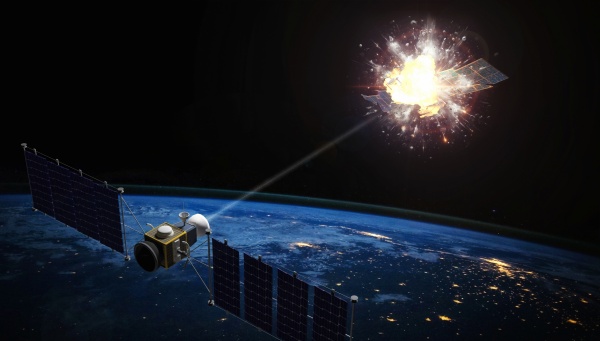
The United States has officially confirmed for the first time that it is deploying and operating weapons in space orbit.
On Sept. 14 local time, IT outlet Ars Technica reported that U.S. Air Force Secretary Troy Meink (트로이 마인크) said at the Air & Space & Cyber Conference of the Air & Space Forces Association held near Washington that the United States has deployed “space-control weapons” in orbit to defend space assets and joint forces from hostile actors.
He did not disclose specific details such as the type of weapons, how they are operated, or when they were tested and deployed. Meink said he would confirm their existence for deterrence, but that releasing details would not help strengthen deterrence.
The remarks draw attention because they effectively amount to an official acknowledgement of orbital weapons systems that the United States has long avoided discussing publicly. U.S. military authorities have recently been increasingly open in referring to space warfare capabilities, including satellite defense, orbital combat and anti-satellite weapons to disable enemy satellites.
Behind this is U.S. wariness about space weapons development by China and Russia. Meink told reporters that with China and Russia developing such weapons, the United States must also have the ability to protect its space assets.
The U.S. government has previously pointed out that Russia tested a system believed to be an in-orbit anti-satellite weapon in 2020 and deployed an operational anti-satellite weapon in 2024. China is also assessed to be expanding its surveillance and response capabilities in space, including operating satellites that maneuver around U.S. military satellites.
The identity of the weapon disclosed this time remains unclear. Some have raised the possibility that it is a non-destructive counterspace weapon that disrupts radio waves or interferes with communications and sensor functions, rather than physically destroying satellites.
The reason the United States prefers non-destructive weapons is space debris. Physically destroying a satellite can create large amounts of debris that could threaten other satellites and space infrastructure. By contrast, radio jammers, signal-disruption devices and lasers used to interfere with sensors can limit functionality without directly destroying the target.
It is unclear whether disclosing only the weapon’s existence, without revealing actual performance and conditions for use, will translate into meaningful deterrence. Experts point out that if an opponent cannot know what capabilities exist, it is difficult to accurately assess the level of threat.
Conversely, the announcement could also spur responses from China and Russia. One analysis says that by officially acknowledging the deployment of orbital weapons, the United States has given rival countries a pretext to publicly justify their own development and deployment of space weapons.
Ultimately, the announcement increases the likelihood that the space arms race will enter a more open phase. It is expected to become a new variable what kinds of orbital weapons the United States will disclose in the future and how China and Russia will respond.
 Jinju Hong
hongjj@d-today.co.kr
Jinju Hong
hongjj@d-today.co.kr