
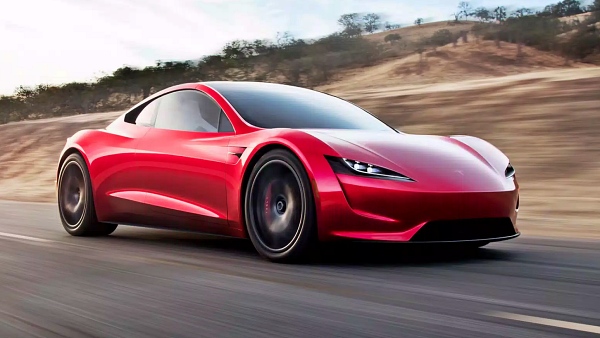
[DigitalToday reporter Jinju Hong (홍진주)] Interest is growing over whether Tesla’s long-delayed next-generation electric sports car, the Roadster, will finally take shape after the company set an unveiling schedule.
According to IT outlet TechRadar on Monday, Tesla recently posted a Roadster teaser image on its official website and announced an Oct. 1 unveiling. Tesla’s official X account also posted the date “10.01” with the phrase “Go for launch”. The event is set to be held in Waco, Texas.
The teaser shows what appears to be part of the Roadster’s rear light and a structure resembling a large rear spoiler or rear diffuser. A section that appears to be a gas-dispensing device was also spotted under the vehicle, drawing attention to whether the cold-gas thruster device Musk mentioned in the past will be applied in practice.
The next-generation Roadster has been repeatedly delayed since it was first unveiled in 2017. Tesla said at the time it would target a range of up to 620 miles on a single charge, acceleration from a standstill to 60 mph in under 2 seconds, and a top speed of 250 mph. Those performance figures remain on Tesla’s Roadster page.
The Roadster also carries symbolic meaning in Tesla’s history. The first-generation Roadster, developed based on the Lotus Elise, played an important role in Tesla establishing itself as an electric vehicle maker. After the second-generation model was unveiled, many consumers also placed reservations as expectations rose for a high-performance next-generation electric sports car.
But as the launch was delayed for a prolonged period, cases of reservation cancellations continued. Marcus Brownlee, known as the popular automotive and IT YouTuber MKBHD, is also cited as an example of someone who gave up a reservation after a long wait.
The biggest focus for this unveiling is performance. Musk has previously said the Roadster could use cold-gas thrusters developed by SpaceX. The device has been discussed as a way to significantly boost straight-line acceleration. With Musk having even made remarks suggesting the Roadster could float or fly, attention is also on whether a related technical demonstration will take place at the event.
Still, a variable is that there has been a gap in the past between Tesla’s flashy technology demonstrations and actual commercialisation. Tesla unveiled the Cybercab and Optimus at its 2024 “We, Robot” event, but later faced claims that humans had intervened during demonstrations. The Cybercab was also assessed as having driven only in a restricted environment.
Market attention is therefore expected to focus beyond whether it is simply unveiled, to whether it can actually be sold and to the mass-production timeline. With Tesla’s passenger-car sales heavily dependent on the Model 3 and Model Y, it matters whether the Roadster remains a symbolic technology demonstration or leads to an expansion of the company’s product lineup.
Attention is on whether Tesla can present detailed specifications and even mass-production plans for the Roadster at its Oct. 1 unveiling, ending the long delay.
 Jinju Hong
hongjj@d-today.co.kr
Jinju Hong
hongjj@d-today.co.kr