
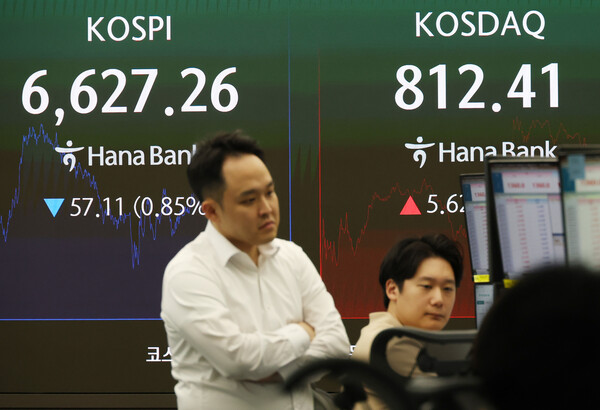
South Korea's KOSPI fell for a fourth straight session on Monday as foreigners and institutions sold shares. Heavyweight chipmakers including Samsung Electronics and SK Hynix were weak as the impact of rising U.S. long-term yields and a sharp drop in U.S. semiconductor stocks lingered.
The KOSPI ended down 57.10 points, or 0.85 percent, at 6,627.26. It opened down 25.12 points, or 0.38 percent, at 6,659.25. It rebounded to the 6,700 level during the session but turned lower as foreign and institutional selling continued.
In the main board market, foreigners were net sellers of 1.57 trillion won and institutions sold a net 903.8 billion won. Retail investors bought a net 831.9 billion won.
Among the most heavily capitalised stocks, chipmakers extended losses. Samsung Electronics closed down 0.20 percent at 248,500 won and SK Hynix fell 0.41 percent to 1,690,000 won.
Samsung Electro-Mechanics fell 1.50 percent, Hyundai Motor lost 1.21 percent, Samsung Biologics slid 0.56 percent, KB Financial Group dropped 3.19 percent and Samsung Life fell 4.19 percent.
LG Energy Solution rose 3.98 percent, while SK Square was flat.
The KOSDAQ closed higher. The index rose 5.62 points, or 0.70 percent, to 812.41.
In the Seoul foreign exchange market, the won ended at 1,359.40 per dollar, down 10.90 won, or 0.81 percent, from the previous session.
Han Ji-young (한지영), an analyst at Kiwoom Securities, analysed that the U.S. 10-year Treasury yield breaking above 5 percent and the sharp drop in U.S. semiconductor shares weighed on South Korean stocks. She said recent controversy over overheating in artificial intelligence investment and rising volatility in the semiconductor sector have put the leadership of domestic chip stocks to the test.
Han said that while semiconductor concentration and one-way moves have eased recently compared with Samsung Electronics, the direction of semiconductor share prices, which account for about 54 percent of the KOSPI's market capitalisation, remains a variable that market participants find difficult to ignore.
She added that AI development has not been halted and no signs have emerged of reduced AI investment by major U.S. big tech firms or weakening memory demand. She said it is necessary to check through the earnings season for major U.S. big tech companies.
 Sangyeob Oh
yub@d-today.co.kr
Sangyeob Oh
yub@d-today.co.kr