
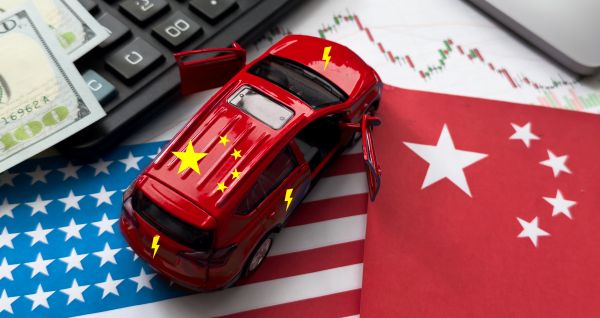
U.S. President Donald Trump said he could allow Chinese automakers to enter the United States if they produce vehicles in the country. But a 100 percent tariff on Chinese-made cars and curbs on U.S. sales of vehicles equipped with software and hardware developed in China remain in place, leaving significant regulatory hurdles to an actual entry.
On Sept. 14, electric vehicle outlet InsideEVs reported that Trump said in an interview with Fox News he could accept Chinese companies if they build factories in the United States and produce cars locally.
Trump said, "I am okay with China coming in here and opening plants and wanting to make cars here," adding, "Japan does it, too, and they hire our people. The important thing is hiring our people." He drew a line against Chinese companies making vehicles in Mexico and exporting them to the United States to bypass trade rules.
The remarks diverge somewhat from Washington's existing regulatory stance toward Chinese cars. The United States currently imposes a 100 percent tariff on cars made in China. It has also put in place rules restricting the U.S. sale of vehicles that use software or hardware developed by Chinese companies. The software-related rules take effect from 2027, and the hardware-related rules from 2030.
The restrictions are not merely declaratory. They are being used as a basis to limit access to the U.S. market for vehicles linked to Chinese technology. Polestar has faced restrictions on sales in the United States, and Mercedes-Benz has been flagged as potentially facing friction with the U.S. government over technology links to China. As a result, even if Trump says he could allow Chinese automakers to produce in the United States, Chinese car sales would not become immediately possible as long as the existing regulatory framework remains unchanged.
There has also been pushback in politics. Michigan Senator Elissa Slotkin (일리사 슬롯킨) recently warned that negotiations between the United States and China could include provisions allowing Chinese cars to enter the U.S. market. She is also a co-sponsor of legislation that would impose a blanket ban on sales of Chinese cars in the United States.
Wariness inside the U.S. government over China-linked auto and battery supply chains continues. U.S. Transportation Secretary Sean Duffy (숀 더피) recently publicly criticised Ford's Michigan battery plant. The plant employs American workers in the United States to produce batteries, but uses designs and technology through a licensing agreement with Chinese battery maker CATL. The U.S. government took issue with Ford's links to the Chinese company.
Trump, by contrast, has repeatedly mentioned the possibility of improving relations with China. While criticising the trade deficit, intelligence issues and China's role in the Iran war, he has also made remarks that appraise Chinese President Xi Jinping (시진핑) positively.
The latest remarks can also be seen as a reaffirmation of Trump's long-stated position rather than a new stance. During his 2024 presidential campaign, Trump also said in effect that Chinese automakers could sell in the U.S. market if they produce cars in the United States.
Whether Chinese automakers actually enter the United States is expected to depend on future U.S.-China negotiations and regulatory adjustments. Xi is due to visit the United States later this month to meet Trump. For now, a 100 percent tariff and restrictions tied to Chinese software and hardware remain in place, and Trump's remarks alone do not mean Chinese cars have been cleared to enter the U.S. market.
 Seung-a Yoo
ysah@d-today.co.kr
Seung-a Yoo
ysah@d-today.co.kr