
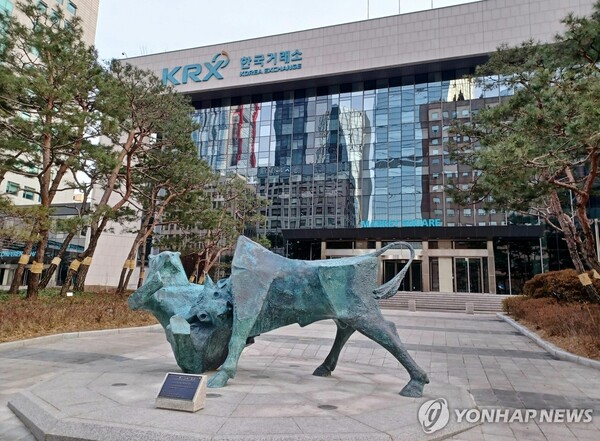
The Korea Exchange (KRX) after-market recorded 1.8 trillion won in turnover on its first trading day. Trading took place in 96 percent of eligible stocks, and retail investors accounted for 93 percent of participants.
The Korea Exchange said opening the after-market, which operates from 4 p.m. to 8 p.m. on Sept. 14, resulted in first-day turnover of 1.8 trillion won and volume of 72.24 million shares. The existing after-hours single-price trading from 4 p.m. to 6 p.m. was abolished and switched to a real-time continuous trading system.
By market, turnover was 1.3 trillion won for the KOSPI and 492.4 billion won for the KOSDAQ. After-market turnover was 6.6 percent of the KRX's total turnover of 27.6 trillion won on the day.
Actual trading took place in 2,413 of 2,501 eligible stocks. That is 96 percent of the total eligible stocks, and 99 percent by market capitalisation.
Trading by time slot continued into the late session. The share of trading was 19.6 percent from 4 p.m. to 5 p.m., 25.5 percent from 5 p.m. to 6 p.m., 24.2 percent from 6 p.m. to 7 p.m., and 30.7 percent from 7 p.m. to 8 p.m. The latest slot, from 7 p.m. to 8 p.m., had the highest share.
By investor type, retail investors accounted for 93.0 percent of total trading. Foreign investors accounted for 3.9 percent and institutions 2.1 percent.
Retail investors were net buyers of 53.7 billion won in the after-market. Foreign investors were net sellers of 48.0 billion won, and institutions were net sellers of 6.3 billion won.
Orders were placed mainly through mobile trading systems, or MTS. Of all orders, the share of trading through wireless devices was 73 percent, while home trading systems, or HTS, accounted for 21 percent.
Price moves were relatively more stable than in regular trading. The after-market high-low volatility by stock was 2.9 percent for the KOSPI and 4.6 percent for the KOSDAQ. That was lower than 4.1 percent for the KOSPI and 5.8 percent for the KOSDAQ in the regular session on the day.
With the opening of the after-market, the number of stocks that can be traded after work expanded from about 600 to most KOSPI and KOSDAQ stocks. Excluded are stocks not traded in the regular session on the day, stocks under administrative issues, ultra-low liquidity stocks, and stocks requiring market management such as those under investment caution or risk designations.
The Korea Exchange expects investors will be able to reflect overseas indicators, corporate disclosures and macroeconomic events announced after the close of the regular session in share prices in real time, accelerating portfolio adjustments.
It also expects access for foreign investors to expand. It said the move can widen trading opportunities for overseas investors who had difficulty trading during the domestic regular session due to time differences.
A Korea Exchange official said the after-market operated stably on the first day, adding: "We plan to continuously monitor and manage it so that it can settle in stably in the future."
 Oh Sang-yup
yub@d-today.co.kr
Oh Sang-yup
yub@d-today.co.kr