
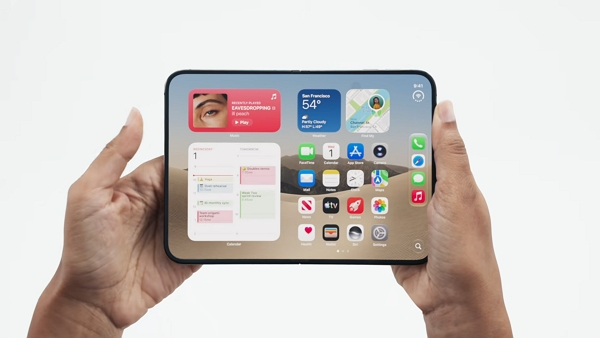
Apple has unveiled the foldable iPhone Duo as expected. In terms of physical design, it marks the biggest change in iPhone history.
But foldable smartphones are not new, and they are not a mainstream segment by market share. Even as foldables improve, criticism persists that they are less durable than conventional smartphones. The cost is also significant. The iPhone Duo is set to be released in October at $1,999, higher than Samsung Electronics’ $1,900 Galaxy foldable.
So why did Apple join the foldable iPhone race?
A recent New York Times report said the new design used in foldables could help strengthen its position again in the premium smartphone market. It said foldables can still serve as a differentiator in a market crowded with lookalike conventional smartphones.
As rectangular smartphones improve in performance, it is becoming harder to distinguish differences between high-priced products and cheaper models. Carrying a smartphone with three camera lenses instead of two is unlikely to attract attention at a party, the New York Times reported.
Nabila Popal, a director at market research firm IDC, said, “It is like a handbag. Why would someone buy Chanel rather than another bag? It is not because of the leather. It is to show that they have Chanel and that they are someone who can buy it.”
Some view the smartphone industry's move toward foldables as similar to tactics used by TV makers.
As high-definition TVs became widespread and anyone could buy a bright, large and clear TV for about $500, companies such as Panasonic, LG and Sony introduced uniquely designed TVs in the $3,000 range as part of efforts to expand profits, the New York Times reported. It said those models included curved displays or the ability to play 3D movies.
Those efforts ultimately did not succeed, but industry moves to differentiate with premium TVs continued. The industry eventually found success with products using organic light-emitting diode, or OLED, panels, the New York Times reported.
The smartphone market has also been making it increasingly difficult to persuade consumers to switch to new products. As AI drives a sharp increase in semiconductor demand, prices of electronic products are also continuing to rise.
In this environment, foldables are expected to serve as a growth engine even if their share is not large.
IDC said global smartphone sales are expected to fall 17 percent this year amid price rises driven by semiconductor supply shortages. It forecast foldable phone sales would rise 12 percent to 22.9 million units on the back of the iPhone Duo launch.
How much the still non-mainstream foldable phone market expands with Apple’s entry will also be a point to watch. Expectations persist that even Apple will not find it easy to grow the foldable market.
Consumers are reluctant to buy foldables not only because of high prices but also because of inconvenience and constraints in use, the New York Times reported. It said foldable screens are less durable than conventional smartphone displays protected by hard glass, and can feel thicker and heavier in a pocket when folded.
Apple said it used a material for the foldable inner screen that is more durable than rivals’ products, but removing some components to make the device thin could be a negative factor. The iPhone Duo lacks the advanced camera system used in the $1,199 iPhone 18 Pro and offers a fingerprint sensor instead of facial recognition.
 Chi-gyu Hwang (황치규)
delight@d-today.co.kr
Chi-gyu Hwang (황치규)
delight@d-today.co.kr