
We use "telecommunications" and "broadcasting" every day. Behind them, unseen technology competition and industrial change continue. Shin Tong Bang Tong is a series that explains telecommunications and broadcasting technology and market trends in an easy and engaging way. It looks at the latest technology, policy and market shifts with on-the-ground context.
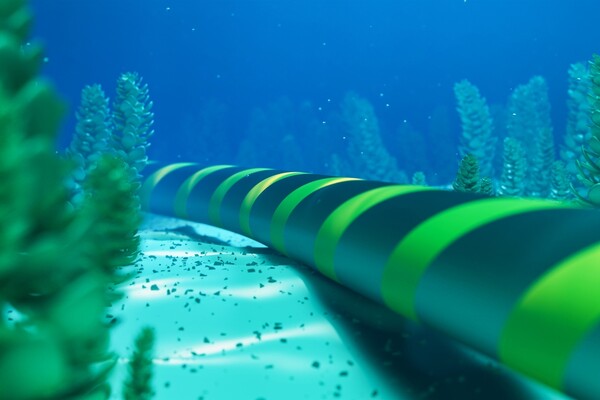
Beneath the sea, which covers more than 70 percent of the Earth's surface, another huge communications network stretches out. It is made up of "undersea cables" that connect continents and carry data produced around the world.
As satellite communications such as Starlink develop rapidly, it is easy to think cross-border communications will take place through the sky. But the vast majority of international data transmission still travels under the sea. The International Telecommunication Union (ITU) says undersea cables handle more than 99 percent of global international data flows. More than 500 undersea cable systems are in operation worldwide, with a combined length of about 1.4 million km.
The spread of AI and cloud services is further increasing the role of undersea cables. As AI data centres are built in many regions, the frequency and scale of data moving across borders are both growing.
◆Data crossing distant seas... the key is "light"
The core of an undersea cable is the optical fibre at its centre. Optical fibre is a thin strand made of glass or plastic that transmits data in the form of light rather than electrical signals. When a user sends data to an overseas server, telecommunications equipment converts the digital signal into a laser optical signal and sends it through the fibre. The light travels along the inside of the fibre and is converted back into digital data by equipment on the other side.
The optical fibre itself is about as thick as a strand of hair. Undersea cables surround the fibre with multiple layers, including metal tubing, insulation and waterproofing. In coastal sections where contact with ship anchors or fishing gear is more likely, steel wire is added to withstand external shocks.
A single optical fibre does not carry only one type of data. It also uses wavelength division multiplexing (WDM), which sends data simultaneously by loading it onto different wavelengths of light. It is similar to dividing a single road into multiple lanes and running cars in each lane at the same time. Recently, the number of fibre pairs inside a single undersea cable has also been increased. It boosts the total volume of data a cable can carry by increasing both the wavelengths available on each fibre and the number of fibres.
The problem is that optical signals also weaken as distance increases. When a cable is longer than 10,000 km, such as one linking South Korea and the United States, it is difficult to send the original light all the way to the other side. The device that solves this is an "optical repeater". Installed at regular intervals along the cable, it amplifies optical signals that weaken during transmission.
A repeater strengthens the signal and sends it to the next segment, and the next repeater repeats the same task so data can cross the sea. Separate power-generation facilities are not installed to run repeaters. Undersea cables include conductors that carry power as well as optical fibres that carry data. Electricity supplied from land travels along the cable to operate repeaters installed over stretches of thousands of kilometres.
◆Cable landing stations, the gateway linking sea and land
Data arriving on land via an undersea cable is not sent directly to smartphones or PCs. It must pass through a "Cable Landing Station", a facility that connects undersea cables and terrestrial communications networks.
A cable landing station is a kind of gateway linking an undersea network and a terrestrial network. It receives optical signals coming in from overseas via undersea cable and sends them to a carrier's domestic backbone network. Data created domestically is sent the other way, placed onto the undersea cable and transmitted overseas.
For example, when a user in South Korea enters a question into an AI service hosted at a U.S. data centre, the data first travels through a mobile network or wired internet network to reach the domestic backbone. It then arrives at a cable landing station and is carried by undersea cable to a U.S. cable landing station. It takes only seconds on screen, but in reality it passes in sequence through domestic networks and landing stations, undersea cables stretching thousands of kilometres, and overseas networks.
To install an undersea cable, the underwater environment must first be surveyed. The cable route is set by analysing seabed topography, depth and geology, as well as earthquake risk, fishing activity and shipping traffic. A dedicated cable-laying ship carrying thousands of kilometres of cable then moves along the route and lays it. In deep ocean areas, cables are often placed on the seabed, but in waters closer to land they can be buried below the seabed. This is to prevent cables from being cut by ship anchors or fishing boats.
If a cable is damaged, a dedicated repair ship is dispatched. Telecommunications equipment is used to estimate the location of the fault, and the repair ship pulls the undersea cable up to the surface after arriving on site. It cuts out the damaged section, splices in a new cable, tests whether optical signals are transmitted normally, and lowers it back into the sea.
If the fault point is thousands of metres deep or weather conditions are poor, the work itself is not easy. Repair ships must travel to the site, and permits are also needed when working in the waters of other countries. For this reason, it is also important in the undersea cable business to be able to reroute data along other paths. The more undersea networks on different routes are secured, the lower the risk that a fault in one cable spreads into an overall decline in quality.
◆Undersea network investment expands as AI data centres spread
In South Korea, investment in undersea cables is continuing to respond to rising international data traffic. SK Broadband is a representative example. In July last year, it began commercial service for the Southeast Asia-Japan Cable 2 (SJC2), which links 10 locations across 7 Asian countries including South Korea, Japan, Singapore and Hong Kong over 10,500 km. In South Korea, SKB participated alone. It has data-handling capacity of 9 terabits per second. That is fast enough to download 281 full-HD films in 1 second.
It is also building a trans-Pacific network beyond Asia. In March last year, SKB joined a consortium to build the E2A undersea cable connecting South Korea, the United States, Japan and Taiwan. With a total length of about 12,500 km, E2A links major digital hubs in Asia and the United States including Busan in South Korea, Maruyama in Japan's Chiba prefecture, Toucheng in Taiwan's Yilan county and Morro Bay in California.
The backdrop to the attention on undersea cables is the expansion of AI data centres. As servers that train and run inference for AI models are distributed across data centres around the world, the importance of large-capacity networks has been highlighted. No matter how many data centres are built globally, it is difficult to exchange data smoothly if international networks linking them are insufficient.
AI services in particular often move large training datasets and models between data centres in different regions, or send user requests to computing resources located overseas. As important as the computing performance of data centres themselves are the capacity and stability of the networks that connect them. Satellites have the advantage of quickly connecting wide areas. Undersea cables, by contrast, are strong at continuously sending large volumes of data. For carriers, undersea cables become a foundational business linking data centres, cloud services and dedicated corporate lines.
As dependence on undersea cables grows, ensuring stability is a task. It is also important to secure dedicated vessels and specialised personnel to repair faults quickly, and to make cross-border recovery procedures run smoothly. Along with increasing transmission volumes, another standard of undersea network competitiveness is how diverse a set of unbroken routes can be secured.
Unlike prominent base stations or data centres, undersea cables are rarely seen in daily life. But in the age of AI and cloud, much of the large-capacity communications linking countries and data centres is still handled by optical fibre laid on the seabed thousands of metres below. As data volumes grow, the role of this invisible "undersea highway" is expected to increase.
 Jin-ho Lee
jhlee26@d-today.co.kr
Jin-ho Lee
jhlee26@d-today.co.kr