
Kakao Mobility presented a direction for commercialising autonomous driving by expanding services tailored to the urban environment.
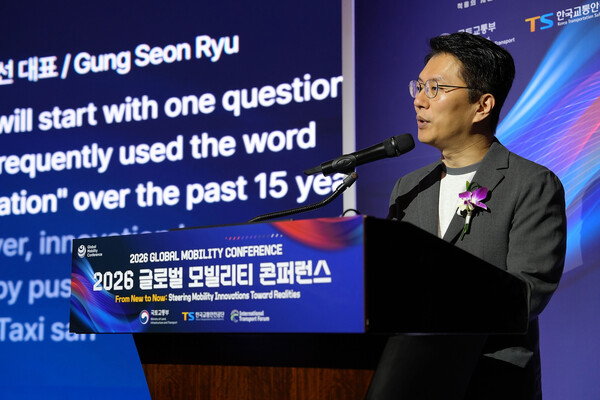
Kakao Mobility CEO Ryu Geung-seon (류긍선) delivered a keynote address on Sept. 7 at the 2026 Global Mobility Conference, jointly hosted by the Ministry of Land, Infrastructure and Transport, the Korea Transportation Safety Authority and the International Transport Forum. Under the theme "Autonomous driving technology into everyday mobility," he stressed the need to consider how technology becomes part of daily life, beyond improving the completeness of autonomous driving technology.
Ryu pointed to completing services in citizens’ daily lives and coordinated, city-scale operations as the core of commercialising autonomous driving. Simply introducing technology into existing modes of transport does not complete commercialisation, he said, adding that it expands in three stages: driving technology, services and urban infrastructure.
He added that autonomous driving, like past shifts from walking or horse-drawn carriages to cars that led to roads, traffic lights and crosswalks, requires changes in urban spatial design and social infrastructure. He said the criteria for evaluating autonomous driving services should also shift from how well a single car drives to how hundreds of vehicles are operated within a city.
Ryu proposed quickly designing an autonomous driving ecosystem in which technology, manufacturing, the public sector and academia participate together, introducing global market trends in which the entire industry structure is being newly reorganised beyond vehicle production and driving technology.
Kakao Mobility is internalising core technologies, including high-definition maps, simulators, control systems and an integrated AI model, while directly carrying out autonomous driving technology and vehicle operations. The company plans to build a collaboration model by working with automakers, parts makers, public institutions, local governments and academia on defining service-tailored vehicles, stabilising the supply chain, establishing routes and safety standards, and verifying trip completion rates.
Kakao Mobility is operating its own driving technology and a 24-hour uninterrupted service. Of users of its late-night autonomous driving service in Gangnam, 97 percent used autonomous driving on the existing Kakao T screen without installing a separate app, and the vehicle utilisation rate was 82.5 percent.
Ryu said, "Autonomous vehicles drive alone, but autonomous driving services must be built together." He added, "Based on mobility technology development experience accumulated over the past more than 10 years and platform operation capabilities, we will contribute to creating a sustainable ecosystem in which autonomous driving establishes itself as an everyday transport service through public-private cooperation."
 Daegeon Seok
d2dg@d-today.co.kr
Daegeon Seok
d2dg@d-today.co.kr