
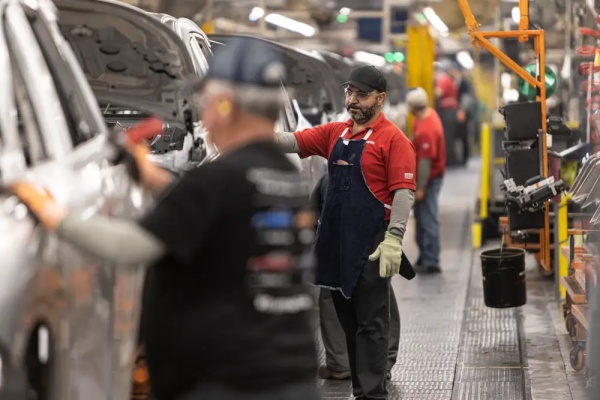
Nissan is expanding automation of parts transport at its Smyrna plant in Tennessee by deploying AI-based autonomous mobile robots. It aims to shift logistics work on the production floor to robots to cut labor costs and production time and boost the plant’s competitiveness.
Business Insider reported on Sept. 4 local time that Nissan is pushing an autonomous mobile robot introduction project as the plant’s largest cost-cutting task this year. Once completed, robots will replace parts transport work currently handled by 64 forklift and tugger drivers.
Nissan plans to deploy the robots in six phases over the coming months. The first phase is set to be completed this year. The Smyrna plant produces the Nissan Rogue, Pathfinder and Murano, as well as the Infiniti QX60, and additional vehicle production is scheduled for next year.
The robots being introduced are made by OTTO, an autonomous mobile robot company under Rockwell Automation. Unlike existing automated transport equipment that follows magnetic tape installed on the floor, they use lidar, cameras and various sensors to detect people and obstacles and set their own routes.
The largest model can carry a load of about 4,190 pounds, or about 1,900 kg, and has a top speed of about 4.5 miles per hour.
The robots are currently used to move parts in the body shop at the Smyrna plant. After a forklift driver moves a parts rack from the truck dock to a staging area, an autonomous mobile robot moves under the rack, lifts it by about 2.5 inches and delivers it to a worker. The worker feeds the delivered parts into a robotic production cell.
Nissan says the focus is that the robots do more than simply move items instead of people. Autonomous mobile robots can connect to factory production equipment and adjust transport schedules in real time.
If a specific production cell stops and no longer needs parts, a scheduled delivery can be cancelled. If one robot’s work is delayed, another robot takes over the task. This effectively optimises the logistics flow automatically to match production conditions.
Nissan said there were also trial-and-error issues during adoption. Initially, a software error caused 2 autonomous mobile robots to move to the same location at the same time, creating a kind of “traffic jam” inside the plant. Nissan later worked with the software supplier to modify the program.
Nissan explained that linking existing factory systems and automation equipment was more difficult than the robots themselves. That is why staff from the automation system integrator respond on site at all times. It will also keep existing staff and equipment for the time being to prevent production line stoppages. Nissan has set up a backup system so forklift drivers can immediately transport parts if a problem occurs in the automation system.
It is also carrying out workforce reassignment. Nissan plans to support employees so they can move to other roles in the plant instead of laying them off, although the existing logistics transport role itself will shrink. Some employees will also receive training related to industrial robots and production equipment.
Nissan plans to pursue long-term labor cost reductions by not refilling positions reduced through natural attrition. Employee reactions were mixed, according to the report. The company shared the plan about 4 months before introducing automation, but worries about job losses were significant at the outset, it said.
The project also ties into Nissan’s broader cost-cutting strategy. Separately from vehicle sales, the company is reviewing costs across vehicle production, including supply chains, warranties, development expenses and labor costs. It is also working in parallel to reduce the time required to produce a single vehicle.
Nissan expects the introduction of autonomous mobile robots to improve cost competitiveness at the Smyrna plant and help secure additional model production in the future. It aims to boost productivity and strengthen competitiveness as a U.S. production base.
Nissan is also reviewing plans to expand the use of autonomous mobile robots or automated forklifts beyond the body shop into stamping processes. It is looking at introducing similar robots into general assembly processes as well, and related projects could start as early as 2027.
Ultimately, the project shows a shift in which AI and robots at auto plants replace not only production itself but also the logistics area of moving parts. Nissan plans to expand the scope of automation step by step after weighing technological maturity, costs and the feasibility of integrating with existing production systems.
 Jinju Hong
hongjj@d-today.co.kr
Jinju Hong
hongjj@d-today.co.kr