
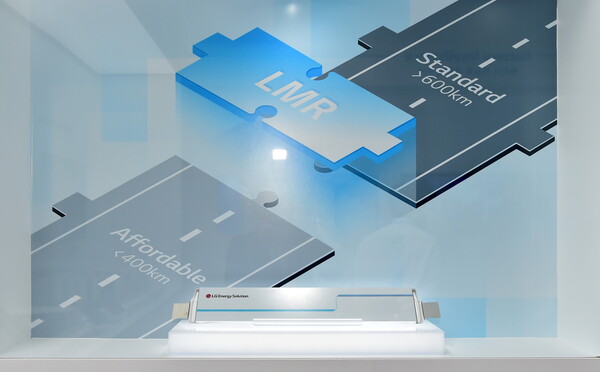
LG Energy Solution and Seoul National University have resolved an obstacle to commercialising next-generation lithium manganese-rich batteries, known as LMR batteries. LG Energy Solution said on Sept. 7 it achieved results that increase the feasibility of applying LMR batteries to large electric-vehicle cells through joint research with a team led by Professor Jong-woo Lim (임종우) of Seoul National University's chemistry department.
LMR is a next-generation cathode material that can cut material costs by using low-cost manganese as a main ingredient without cobalt. It can also deliver high energy density by using not only transition metals but also oxygen inside the material for energy storage. But if oxidised oxygen during charging does not fully recover in the discharge process, it can lead to internal structural damage and gas generation. In large EV cells with limited internal space, this directly causes rising pressure and performance degradation, and has been seen as the biggest challenge to commercialising LMR.
The joint team precisely analysed oxygen oxidation and reduction behaviour under different charge and discharge conditions. It found that the key variable governing oxygen recovery lies not only in the upper charging cutoff voltage but also in the lower discharge cutoff voltage. When the upper cutoff voltage was lowered to 4.3V from 4.6V, the reduction rate of oxidised oxygen rose to 97% from 86%. The team also confirmed that when discharge was carried out to 2.0V rather than the previous 3.0V, oxygen almost returned to its original state.
Based on the analysis, LG Energy Solution researchers redesigned the operating voltage range and activation process conditions for a 40Ah-class LMR large cell. They applied a process that lowers temperature during the activation stage to suppress gas generation specific to large cells. A 40Ah-class LMR large cell under optimised conditions retained 92.2 percent of its initial energy even after 883 charge and discharge evaluation cycles. The result demonstrated the commercialisation potential of LMR materials at a large-cell level that can be mounted in actual electric vehicles, beyond small cells.
Lim said the research identified the cause of degradation in LMR batteries from the perspective of oxygen reversibility and showed that cell stability can be improved through electrochemical protocol design alone. He said the work confirmed that long-term stability of LMR batteries can be secured only when discharge conditions are comprehensively considered as well as charging conditions.
An LG Energy Solution official said the research effectively suppressed gas generation, a major task for LMR batteries, showing that stable battery life can be secured even in large cells. The official said it laid the groundwork to accelerate growth in the next-generation LMR battery market.
The findings were published in the international journal Nature Communications.
 Dae-geon Seok
d2dg@d-today.co.kr
Dae-geon Seok
d2dg@d-today.co.kr