
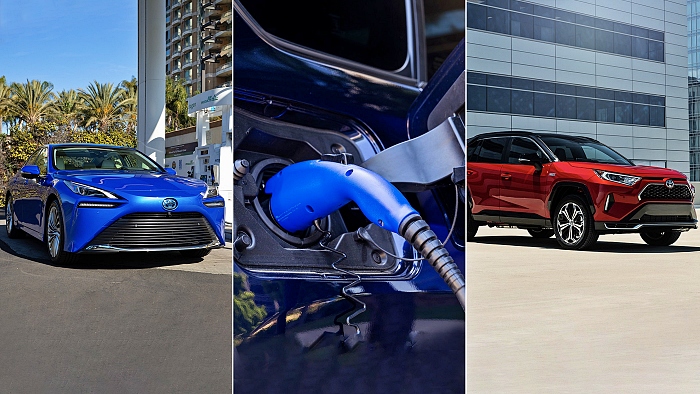
[DigitalToday reporter Hyunwoo Choo] Battery electric vehicles still have advantages in efficiency and maintenance convenience, but a driver case has emerged showing that a plug-in hybrid can be a more realistic choice depending on charging conditions and travel patterns. On Sept. 5, electric vehicle outlet Cleantechnica introduced a family case involving experience with both battery electric vehicles and plug-in hybrids.
The writer explained that battery electric vehicles are more convenient for daily driving and have a simpler structure. They avoid the burden of oil changes and emissions inspections, and are advantageous for maintenance because they lack a transmission, exhaust system and emissions control devices. Plug-in hybrids, by contrast, have both an electric drivetrain and an internal combustion drivetrain, making the structure more complex, the writer noted.
Actual vehicle choice differed depending on the usage environment. The writer's daughter drove a 2018 Tesla Model X and switched this year to a 2026 Toyota RAV4 plug-in hybrid. When she lived near Salt Lake City, Utah, the Model X fit an outdoors-focused lifestyle thanks to about 300 miles of electric driving range and the Supercharger network.
The problem was long-distance travel. Driving with 2 bicycles on a rear rack sharply reduced driving range, and a bike trip from Utah to Oregon became the turning point. She had to stop to charge almost every hour, the writer said, and a trip that would normally take about 8 hours took about 4 additional hours.
Conditions changed further after the family decided this spring to move to a lakeside home in northern Wisconsin. There were not many Superchargers near the new residence, and long-distance trips with bicycles were expected to increase. After reviewing options, the writer chose the 2026 Toyota RAV4 plug-in hybrid. The decision was driven by the electric-only driving range increasing to more than 50 miles.
Satisfaction in real-world use was high. Using a 240-volt charger previously installed for the Tesla, the car could be fully charged in the garage in 2 to 3 hours, and it could drive up to 54 miles on electricity alone. Daily driving was handled in electric mode, and on long trips it could travel more than 500 miles on electricity and gasoline combined, removing the need for charging stops.
The writer also cited charging habits as a weakness of plug-in hybrids. With a U.S. household 110-volt power supply, a full charge takes about 10 hours, and many drivers do not install a separate 240-volt charger or do not charge often, the writer said. Still, charging every time on returning home and using electricity for most daily driving can sharply reduce refuelling frequency while keeping long-distance travel needs in reserve, the writer explained.
 Hyunwoo Choo
cookinpapa@d-today.co.kr
Hyunwoo Choo
cookinpapa@d-today.co.kr