
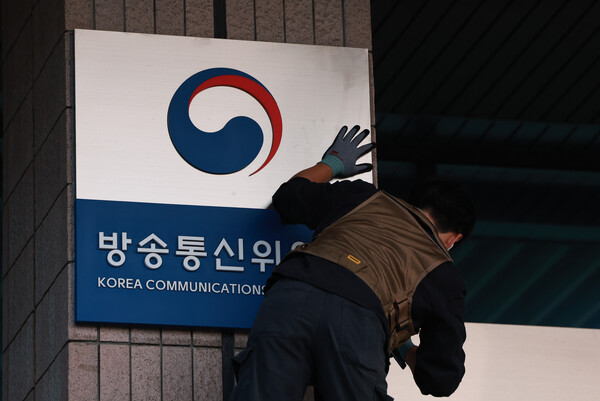
The Broadcasting Media and Communications Commission has been unable to hang its signboard even as it nears its first anniversary. One standing commissioner seat recommended by the People Power Party has remained vacant for more than six months, delaying the legally mandated full seven-member lineup.
The commission is currently run by six members: Chairman Kim Jong-cheol (김종철), standing commissioner Ko Min-su (고민수), and non-standing commissioners Ryu Shin-hwan (류신환), Yoon Seong-ok (윤성옥), Lee Sang-geun (이상근) and Choi Soo-young (최수영). The commission is made up of 7 members including the chair.
The final seat is for a standing commissioner recommended by the People Power Party. In a plenary session on Feb. 26, parliament approved a motion to recommend Ko, nominated by the Democratic Party, but rejected a motion to recommend Cheon Young-sik (천영식), nominated by the People Power Party. The motion for Cheon failed with 116 votes in favour, 124 against and 9 abstentions out of 249 lawmakers present.
More than six months after the motion was rejected, the People Power Party has not completed procedures to recommend a successor nominee. People who had been considered were excluded one after another during the opposition party’s internal vetting, delaying the selection itself, it was reported.
Kim has also repeatedly urged parliament to recommend the final standing commissioner. At a news conference marking 6 months in office in June, he said, "I ask that the National Assembly promptly recommend the remaining standing commissioner so our commission can operate as a full lineup in both name and reality."
At the time, Kim also explained why the commission had delayed selecting a vice chair, linking it to the nature of a collegial body. "We have to elect a vice chair from among ourselves, but we are postponing it in consideration of the character of a collegial body," he said. "Please understand this as reflecting our determination to realise the purpose of a collegial body to the fullest, unlike the previous commission," he added. Still, he also said he would resolve the prolonged vacancy through consultations with commissioners.
The commission eventually elected Ko as its first vice chair on Aug. 21. That was about 10 months after the commission was launched. Ko’s term as vice chair runs until March 31, 2029.
By contrast, the schedule for a signboard ceremony has still not been set. Within the commission, there had been an understanding that holding the ceremony after the seven-member lineup was completed would be natural, it was reported. A commission official said, "There was also an aspect in which the vice chair election was delayed while waiting for the commission lineup, and we had thought about the signboard in a similar way." The official added, "Since the National Assembly has entered regular-session mode, it is still hard to know the timing of a signboard ceremony."
Decisions can still be made under the current six-member lineup. The commission’s law stipulates that meetings are convened with the attendance of a majority of incumbent commissioners and decisions are made with the support of a majority of those present. With 6 incumbent members, a meeting can be held if at least 4 attend.
Still, many inside and outside the commission say it is difficult to fully realise the purpose of a collegial body when a commission launched on the premise of a seven-member system is operating without filling its quota. At the commission’s first full meeting in April, the vacancy of a People Power Party-recommended standing commissioner was cited as a potential variable in future operations, and differences emerged among commissioners over swift handling of pending issues and the legitimacy of the commission as a collegial body.
In particular, on issues where opinions among commissioners diverge sharply, such as licences for broadcasters and sanctions, the joining of the final standing commissioner could also affect the structure of deliberations. Differences also emerged recently in discussions related to approval for a change in YTN’s largest shareholder.
A non-standing commissioner from an opposition party said of the possibility of holding a signboard ceremony before the People Power Party-recommended standing commissioner joins, "I think it is unlikely that the chair will hang the signboard before the seven-member system is in place."
The commission officially launched in October last year with the enforcement of its establishing law. If the People Power Party further delays recommending a successor standing commissioner, the commission could reach its first anniversary without a signboard.
 Seulgi Son
sageson@d-today.co.kr
Seulgi Son
sageson@d-today.co.kr