
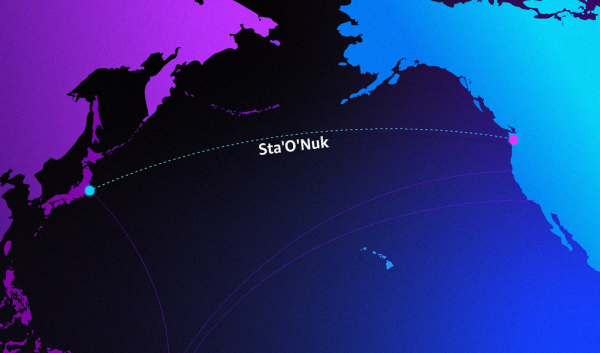
[Digital Today reporter Jinju Hong (홍진주)] Amazon Web Services (AWS) has unveiled Sta'O'Nuk, a new Pacific subsea cable linking Japan and the United States, and set a target to begin operations in 2029.
Japan ITmedia reported on Wednesday local time that the cable consists of 20 fibre pairs and will provide total bandwidth of 420 Tbps.
The core of the project is to diversify landing points rather than simply expand capacity. There are currently about 25 to 30 subsea cables between Japan and the United States, but landing points are known to be concentrated on the U.S. coasts of California and Oregon and on Japan's Chiba Prefecture and the Shima Peninsula in Mie Prefecture. AWS views this geographic concentration as vulnerable to natural disasters such as earthquakes, damage from ship accidents, interference with fishing and geopolitical tensions, and has moved to design a new route.
Sta'O'Nuk plans to use a new landing point in Washington state on the U.S. side instead of existing major landing points. On the Japan side, it will use a range of landing points rather than concentrate on a single site. AWS aims to reduce single points of physical failure through this approach.
The security design is also structured in multiple layers. Communications will be protected by quantum cryptography at Layer 1, MACsec encryption at Layer 2, and TLS/SSL or the QUIC protocol at Layer 4. AWS plans to combine encryption at each layer to improve security across the subsea communications segment.
Risk-reduction measures are reflected in how the landing segments will be built. At each landing site, horizontal directional drilling will be used to bury the cable so it passes beneath the coastline in shallow seabed areas. The physical layer will be designed with multiple routes so failures do not concentrate at a single point. AWS also plans to strengthen physical security by limiting access to landing sites to a restricted number of people.
The project name also reflects the meaning of regional cooperation. Sta'O'Nuk is being 추진되고 under cooperation with the Quinault Indian Nation, a sovereign Indigenous nation officially recognised by the U.S. government, on the Washington state coast where the U.S.-side landing point will be located. The name was taken from an expression in an Indigenous language meaning "thunder snake". AWS said it reflected Indigenous cultural and linguistic meaning in the project.
The cable targets a structural problem in which existing subsea communications networks between Japan and the United States are concentrated in specific areas. As a result, the focus going forward is expected to be less on the 2029 launch timeline itself than on how much AWS can change resilience and the security structure for the Pacific segment by actually implementing new landing points and a multi-route design.
 Jinju Hong
hongjj@d-today.co.kr
Jinju Hong
hongjj@d-today.co.kr