
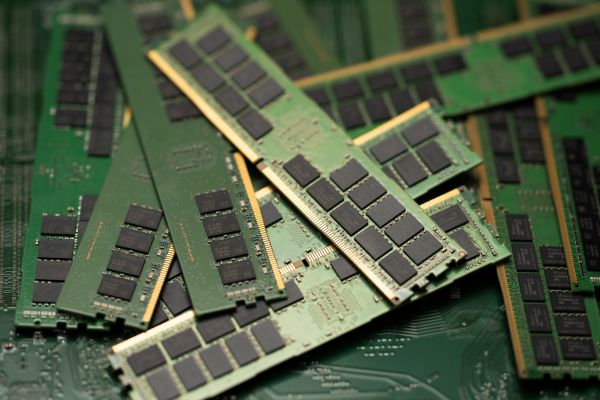
As memory manufacturers shift wafer allocation to high-bandwidth memory (HBM) and DDR5, they have less capacity to produce commodity DRAM. As commodity DRAM prices rise, the cost of smartphones and PCs is increasing, and a vicious cycle is expected in which the burden spills over to parts and materials suppliers.
Industry officials said on Aug. 28 that the cost of making a smartphone or PC is expected to rise at least 15 to 40 percent this year. It is the result of reduced supply of commodity DRAM used in smartphones and PCs as memory makers move production capacity to HBM. Someone among consumers, set makers, parts and materials suppliers, and raw material suppliers will have to absorb the higher costs.
HBM is a memory that stacks multiple DRAM layers to widen data pathways. It goes into artificial intelligence (AI) servers and sells for more than general DRAM. When HBM is made on the same wafer, the amount of DRAM capacity obtained falls by several times. That is because defects occur in the process of bonding stacked chips. DS Investment & Securities said making 1 bit of HBM requires wafer input equivalent to 3 bits of general DRAM, and the actual applied figure next year, reflecting yield, is seven times.
This year, major DRAM producers have nominal wafer capacity of 2,005,000 sheets per month. After factoring in HBM consumption, effective capacity drops to 1,543,000 sheets. Some 462,000 sheets are diverted to HBM. This year's share of HBM in shipments is forecast at 14 percent for SK Hynix and 12 percent for Samsung Electronics. The higher that share rises, the fewer wafers are allocated to commodity DRAM.
The shortage that began in DDR5 has shifted to DDR4, the previous-generation product. Manufacturers are prioritising HBM and DDR5 allocation and cutting DDR4 output because margins are lower. Morgan Stanley expected DDR4 prices to rise by as much as 50 percent in the third quarter from the second quarter, and by more than 10 percent additionally in the fourth quarter.
◆ Set makers intensify pressure to cut component prices (CR)... burden shifts to parts and materials suppliers
DDR4 is still used in enterprise desktops, kiosks and industrial systems. Demand that chose older platforms to avoid costly DDR5 is now also facing the price increases. The shortage of older DRAM has spread beyond the AI server market. The supply-demand fulfilment rate is -5.0 percent this year and -1.9 percent next year. The shortage is expected to persist in the long term. DS Investment & Securities estimated that from 2026 to 2035, effective supply capacity will grow an average 11.9 percent a year, while total DRAM bit demand will increase about 13 percent a year on average.
SK Securities forecast memory prices to rise by triple-digit percentages. It also expected application processors, communications modules and substrates to rise at least 20 to 30 percent and as much as more than 50 percent. It said memory would see the biggest increase. Displays and cameras have higher specifications, and there is little room to cut prices as interior and exterior materials use metal and auxiliary materials rise with chemical material prices.
Rising component prices are also feeding into finished product prices. TrendForce estimated that as HBM and wafer prices rise, Nvidia server GPU prices could increase 10 to 20 percent after the first quarter of 2027.
SK Securities forecast memory prices to rise by triple-digit percentages. It also expected application processors, communications modules and substrates to rise at least 20 to 30 percent and as much as more than 50 percent. It said memory would see the biggest increase. Displays and cameras have higher specifications, and there is little room to cut prices as interior and exterior materials use metal and auxiliary materials rise with chemical material prices.
It is also difficult to pass higher costs on to selling prices. Demand in China is sluggish and global set shipments have contracted since the first quarter. Samsung Electronics' Galaxy is expected to post a sales decline this year, and Chinese companies are planning output cuts of 20 to 35 percent. Costs that cannot be passed on to consumers head to suppliers. SK Securities said the structure leaves set makers with no choice but to strongly demand component and material unit price reductions, known as CR. If parts and materials suppliers cannot absorb it, the burden is expected to shift down to raw material suppliers.
 Dae-geon Seok
d2dg@d-today.co.kr
Dae-geon Seok
d2dg@d-today.co.kr