
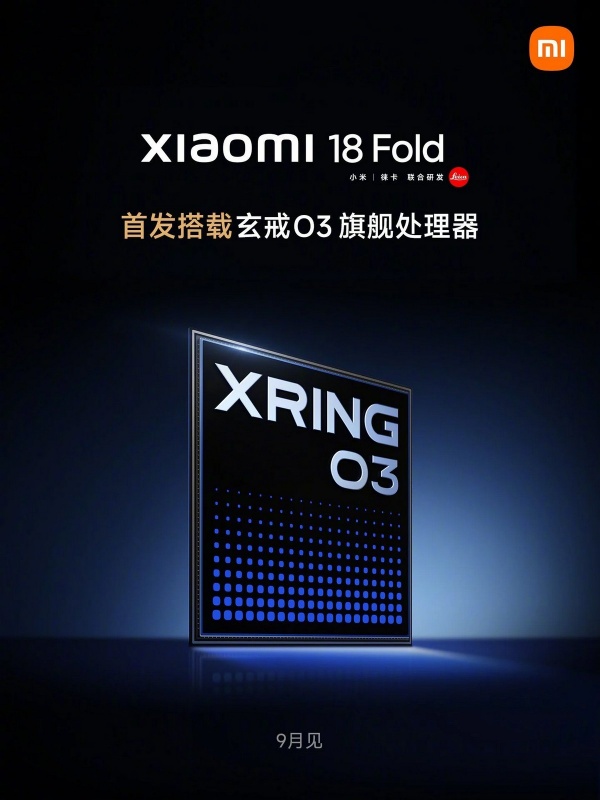
Xiaomi unveiled its self-designed 3-nanometre mobile processor, the Xring O3, accelerating its push to internalise mobile semiconductors. The company is developing in-house chips not only for smartphones but also for AI accelerators and autonomous-driving vehicles, expanding its chip design capability from smartphones to cars and robots.
On Aug. 24 local time, blockchain outlet Cryptopolitan reported that Xiaomi unveiled three self-developed Xring chips. The main processor, the Xring O3, is set to be first installed in the Xiaomi 18 Fold, which will be launched in China next month.
The announcement is drawing attention as it specifies Xiaomi's strategy to replace some mobile chips it has relied on from Qualcomm and MediaTek with in-house designed semiconductors. Xiaomi said the Xring O3 is a smartphone system-on-chip produced using TSMC's 3-nanometre process. The company claimed its internal tests recorded an AnTuTu score of 5,228,014, the first time a mobile SoC has exceeded 5 million points. The figure, however, is a result presented by Xiaomi itself.
The Xring O3 features a 10-core CPU and a 16-core GPU. Xiaomi said that compared with the previous generation chip, CPU performance improved 60 percent, graphics performance rose 85 percent and power efficiency improved 64 percent. It also said the chip is the first mobile processor to support LPDDR6 memory and provides bandwidth of up to 113.8 GB per second.
Xiaomi also highlighted AI performance as a key feature. Xiaomi said the Xring O3 delivers about 200 TOPS of tensor performance and its neural engine processing speed is 45 percent faster than the previous generation. The chip was developed over 459 days and is set to be applied first to the Xiaomi 18 Fold and Pad 9 Pro Max, which will be launched in China in September.
Along with the smartphone processor, Xiaomi unveiled an AI accelerator and an autonomous-driving vehicle chip. The 6-nanometre AI accelerator, the Xring O100, uses a structure that stacks a processor and memory to achieve bandwidth of up to 1.22 TB per second. Xiaomi said the product focuses on reducing latency generated during AI task processing and plans to use it to run AI models inside smartphones, cars and robots. It set commercialisation for 2027.
Xiaomi also unveiled the Xring D100, an autonomous-driving vehicle semiconductor. Xiaomi introduced it as China's first 3-nanometre high-performance smart driving processor. The Xring D100 has a 20-core CPU and a 16-core NPU and supports up to 160 GB of memory. Xiaomi said it can run a large AI model with up to 200 billion parameters. Verification work has been completed, but a version applied to actual vehicles is set to be released in 2027. Xiaomi did not disclose the Xring D100's TOPS performance or the first vehicle model to adopt it.
Xiaomi's in-house silicon strategy is not the first of its kind. Since restarting its semiconductor development programme in 2021, the company has invested more than 21 billion yuan, and about 3,000 engineers are currently involved in chip development. Cumulative shipments of devices equipped with the existing Xring O1 have surpassed 1 million units. Of these, smartphones have sold about 150,000 units since May 2025. The target sales volume for the new foldable phone was presented as 200,000 to 300,000 units.
Xiaomi plans to continue using Qualcomm and MediaTek chips for most of its smartphones. It is expected to lower its reliance on the supply chain and strengthen product differentiation by expanding the use of in-house designed semiconductors in some key product lines.
Securing in-house chips could also be expected to boost bargaining power with component suppliers. Nvidia chips are currently used in Xiaomi's electric vehicles, but if its in-house semiconductor technology expands into the automotive sector, it may broaden its use in electric-vehicle and AI businesses as well.
Xiaomi's move also ties in with competition among China's electric-vehicle industry to internalise semiconductors. Major Chinese electric-vehicle makers such as Nio, Li Auto, Xpeng and BYD have already developed and operated their own driving semiconductors. How much Xiaomi can bear the cost burden as it expands semiconductor internalisation is a variable. The company recorded an operating loss of 2.6 billion yuan over three months through June 2026 in new businesses including electric vehicles and AI.
Ultimately, Xiaomi's in-house chip strategy is expanding beyond simply making smartphone components itself into building its own semiconductor ecosystem spanning smartphones, AI, cars and robots. Actual performance of the chips, the scope of product adoption, and whether this leads to cost reductions and stronger product competitiveness are expected to determine the strategy's success.
 Jinju Hong
hongjj@d-today.co.kr
Jinju Hong
hongjj@d-today.co.kr