
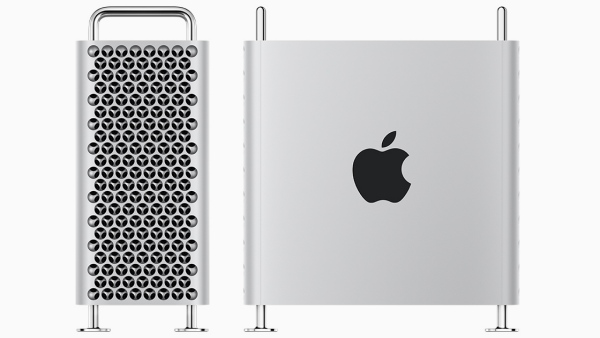
[Digital Today reporter Hyunwoo Choo (추현우)] Apple discontinued the Mac Pro in March and said it has no plans for successor hardware, clearing out its top-performance desktop product line-up. On Aug. 7 (local time), IT outlet TechRadar reported the Mac Pro lost market appeal as the rise of the Mac Studio coincided with higher component prices driven by AI data centres.
The Mac Pro was first unveiled in 2006. Apple introduced it at the time as an ideal system for the most demanding users. It was also the last Mac of the Intel processor transition period. Its performance was about twice that of the Power Mac G5, which was released less than a year earlier.
The Mac Pro, however, targeted a niche market from the start. Its main customers were users who needed high performance for video production or AI data processing. There was demand that prioritised performance and stability even at a high price, but it was not a product expected to sell in large volumes like the MacBook Air or MacBook Pro.
Apple failed to hold on to this customer base consistently. The cylindrical Mac Pro unveiled in 2013 was not updated for a long time, and Apple later acknowledged it had thermal design limitations. It took 6 years after the 2013 model for a newly designed product to emerge.
The arrival of the Mac Studio narrowed the Mac Pro's position further. The Mac Studio was smaller and cheaper but delivered performance comparable to, or higher than, the Mac Pro. After Apple's shift to Apple silicon, additional devices such as the Apple Afterburner card also became harder to realise. In the end, the Mac Pro's strengths were reduced to limited expandability such as PCIe. Given its $6,999 starting price, it was bound to become less competitive.
After news of the Mac Pro discontinuation surfaced on March 26, Apple said it has no plans to release future Mac Pro hardware. Nearly all product prices rose in the following 3 months, and the increases were large for high-end Mac models. The Mac Studio M3 Ultra model rose by $1,300, the biggest jump, and the MacBook Pro increased by $300. Chief Executive Tim Cook (팀 쿡) said these price rises were unavoidable because of a broad component crisis driven by AI data centre demand.
If those increases were applied to the Mac Pro, the starting price would be about $9,299. If the base model alone rose that much, it would be hard to avoid falling sales and price controversy. The Mac Pro exited ahead of its 20th anniversary as niche-market limits, long update gaps, internal competition with the Mac Studio and a sharp rise in component prices converged.
 Hyunwoo Choo
cookinpapa@d-today.co.kr
Hyunwoo Choo
cookinpapa@d-today.co.kr