
Korea Advanced Institute of Science and Technology (KAIST) is working with Nvidia to build more than 1 million Korean-language AI training data entries by next year. It will also establish validation methodologies, laying a foundation for use by domestic AI companies and research institutes.
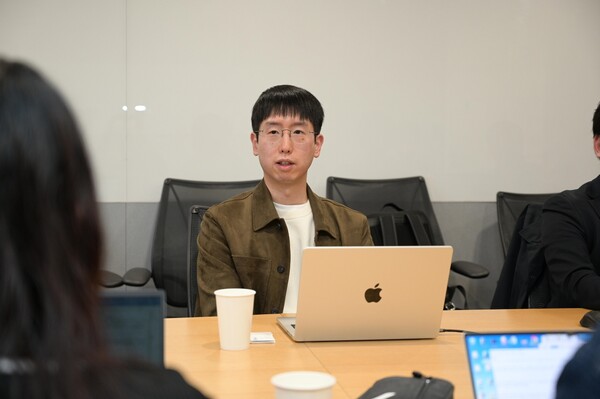
Kim Hyun-woo (김현우), co-head of the KAIST-Nvidia AI Joint Research Center, said in an interview at Nvidia Korea in Seoul's Gangnam district on Monday that the goal is to create at least 1 million Korean-language training data entries next year. He said he would cultivate an AI ecosystem using Korean-language datasets.
Kim, an Nvidia research manager, joined the Kim Jaechul Graduate School of AI as an assistant professor after the plan to establish the joint center was announced in July. As the inaugural head, he likened the growth stage of South Korea's AI industry to a forest where trees are growing. He said individual AI models, like trees, are growing on the back of government support and corporate investment, but data, the soil needed for sustained growth, has received relatively less attention.
He said attention had so far focused on model "trees" and on graphics processing units and research infrastructure, likened to sunlight and water. He stressed that it is now time to cultivate the AI forest with data.
◆ Build 1 million Korean-language training data entries next year... also contributing to K-EXAONE development
The joint lab will focus on generating synthetic data based on Korean and drawing greater learning effects from existing data. It aims to move beyond simply translating English materials into Korean by incorporating natural sentences and diverse situations to support the advancement of homegrown AI models.
If synthetic data repeats similar expressions and answers, learning performance can decline. The lab aims to increase the accuracy of Korean-language datasets and the diversity of correct answers. It also plans to design evaluation indicators to judge how much the data helps actual model training.
It also seeks to differentiate how data is generated. Rather than stopping at modifying existing documents, it will set a character's background and situation from minimal information such as a person's name and then generate long documents step by step. Kim explained that it is important to effectively filter out and correct low-quality Korean data among what is generated.
High-quality Korean-language datasets are also in strong market demand. A Korean-language dataset called "NeMoTron Persona Korea," which Kim developed using Nvidia NeMoTron, was used to develop LG AI Research's "K-EXAONE 2.5." K-EXAONE 2.5 is a technology verification model that applies additional training to the government's second independent foundation model.
NeMoTron Persona Korea ranked No. 1 worldwide on Hugging Face's popular dataset chart for 10 days and logged 140,000 downloads over the same period, drawing strong interest. He plans to continue providing Korean-language datasets suited to advancing homegrown AI.
The lab will release datasets and training methodologies through open source and academic papers so the research results can be applied to other domestic models. Kim said a healthy forest is where diverse trees grow together, and the goal is to build soil by sharing data and training methods that different models can use.
◆ Nvidia to provide support worth $300 million over five years... hiring researchers begins
The joint lab was established based on large-scale investment by Nvidia. Nvidia will provide support worth $300 million over the first five years, including AI computing resources such as GPUs and research operating expenses. Of that, the support for AI computing resources amounts to $250 million. Researchers will use GPU infrastructure through domestic Nvidia cloud partners.
KAIST expects the partnership to further strengthen its global competitiveness in AI research. It will go beyond receiving research funding and equipment from an overseas company to jointly identify research topics with world-class researchers and share outcomes.
Kim described this as a "global fast track." He said it means domestic researchers can directly collaborate with overseas research teams to tackle the latest research problems and spread outcomes to industry. He also stressed that KAIST has world-class AI research capabilities. Nvidia researchers in Santa Clara, California, and KAIST faculty will regularly discuss research directions.
The joint lab is currently recruiting interns and full-time researchers. It will complete its initial research team within this year and begin full-scale research next year. Nvidia will support at least 10 KAIST researchers each year and also offer Nvidia internship opportunities.
Kim said the domestic AI ecosystem can deepen only if KAIST students build experience using data and conducting research themselves. He stressed that he aims to help South Korea's AI ecosystem become a forest where diverse trees and participants come together, rather than stopping at nurturing a single tree.
 Jinho Lee
jhlee26@d-today.co.kr